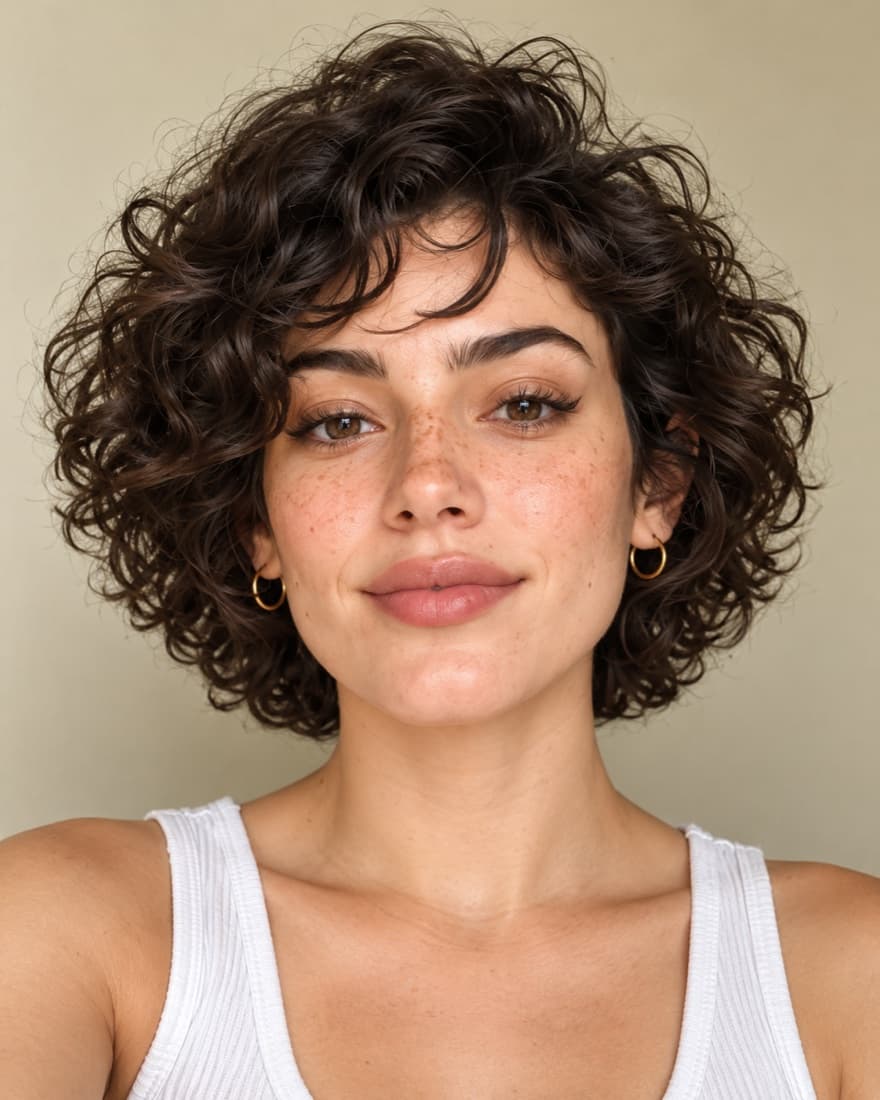
What makes a good celebrity lookalike website?
A good celebrity lookalike website is private, searches a large and properly licensed set of faces, explains why you match, and does not hide results behind accounts or paywalls. Check where your photo goes first: some sites upload and keep it, while others analyze it in your browser. Then look at the size and source of the celebrity database, whether you get several matches with a similarity score, and whether it tells you which features you share. Most sites work the same way under the hood: a face-recognition model turns your selfie into a list of numbers and finds the nearest faces. FaceTwin does this on your device with 128-number descriptors compared against 2,333 public figures whose portraits are freely licensed on Wikimedia Commons, returns your top five with a similarity percentage, and lists the measured traits you share.
- Check privacy, database, explanations, paywalls
- 128-number face descriptors
- 2,333 public figures, Commons photos
- Top 5 with % and shared traits
Lookalikes and more
A checklist for choosing a lookalike site
Before you upload a selfie anywhere, it is worth spending a minute on these six questions. They matter more than the design of the results page.
| Question | What to look for | Red flag |
|---|---|---|
| Where does my photo go? | Analysis in the browser, or a clear deletion policy | Vague terms that let them keep or reuse uploads |
| How big is the database? | Thousands of faces across many fields | A few hundred faces, so everyone gets the same names |
| Does it explain the match? | Shared features, not just a name | One name, no score, no reasoning |
| Where do the celebrity photos come from? | Licensed or public-domain images with attribution | Unattributed photos scraped from anywhere |
| Do I need an account or payment? | Results free without sign-up | Results blurred until you subscribe |
| How accurate is it? | Several matches with a similarity score | Random-feeling results that change every time |
How celebrity face matching works
Behind almost every lookalike site is the same idea from face recognition. A neural network is trained so that photos of the same person produce similar outputs and photos of different people produce different outputs. The output is a face descriptor: a short list of numbers summarizing the geometry of a face.
- Your face is detected and landmarks are placed on it, so the face can be aligned.
- The network turns the aligned face into a descriptor. In FaceTwin’s case it is 128 numbers.
- The same has been done in advance for every celebrity in the database.
- The site finds the nearest neighbours — the celebrity descriptors closest to yours — and ranks them.
- The distance is translated into a friendlier similarity percentage.
The quality of the result depends on the model, the size and diversity of the database, and the photos used for each celebrity. A bigger, better-curated database means your nearest neighbour is genuinely close rather than just the least-bad option.
What the similarity percentage means
Raw descriptor distances are not intuitive, so sites map them to a percentage. There is no industry standard for that mapping, which is why one site’s 95% can be another site’s 70%. FaceTwin calibrated its scale on its own database: a typical closest match scores around 80%, a striking resemblance goes above 90%, and below 70% is a loose resemblance in one or two features. Compare percentages within one site, never across sites.
Common reasons results feel wrong
If your lookalike seems off, it is usually one of these:
- Hair and styling: models compare facial structure, but people judge resemblance largely by hair, colouring and style.
- Head turn and angle: a face turned to the side produces a different descriptor than a straight-on one.
- Expression: a wide smile changes the cheeks, mouth and eye shape.
- Lighting and filters: harsh shadows hide the jaw, and beauty filters reshape features.
- Small database: if the person you resemble is not in the index, you get the closest available face.
- Different photo of the celebrity: the reference photo may show them at a different age or angle from the image you have in mind.
The practical fix is to try two or three straight-on, evenly lit photos. A celebrity who shows up in more than one result is your most reliable match.
How FaceTwin does it
We built FaceTwin around the checklist above. The face model downloads once into your browser, so your selfie and its descriptor never leave your device for the lookalike search. The index holds 2,333 public figures with Wikipedia articles whose portraits on Wikimedia Commons are published under free licences; for each we store the name, the descriptor and the attribution, and the thumbnail you see loads straight from Commons with its author and licence.
You get your top five matches with a similarity percentage, a filter for women, men or everyone, and a sentence on the traits you share — measured with the same geometry as our face analysis, such as face shape, eye tilt, brow arch and jaw angle. No account, no paywall for results, no ads. Public figures do not endorse FaceTwin, we never generate images of them, and anyone in the index can ask for their entry to be removed.
Frequently asked questions
What is the best celebrity lookalike website?
The best one for you is private, searches a large licensed database, shows several matches with a score and explains the shared features — use the checklist on this page to compare.
Are celebrity lookalike websites safe?
It depends on where your photo goes. Prefer sites that analyze the photo in your browser or clearly delete uploads, and avoid ones with vague terms about reusing images.
Is my photo uploaded?
Not for local lookalikes or face analysis: the model runs in your browser, so your selfie, landmarks and descriptor stay on your device. AI portraits, including the first free one, and full reports send your photo through our server to the AI provider after sign-in and separate upload consent. Reports also send your numeric measurements. FaceTwin does not save the original photo; it is discarded from request memory after processing.
How do lookalike sites find who I look like?
A face-recognition model turns your face into a list of numbers and finds the celebrities whose numbers are closest. FaceTwin uses 128-number descriptors and 2,333 public figures.
Why do different sites give different lookalikes?
They use different models, different celebrity databases and different similarity scales, and photo angle and lighting change results too.
Is FaceTwin’s lookalike search free?
Yes. The top five matches, similarity scores, shared traits and the share card are free with no account.
Can I search with a friend’s photo?
Please only use photos of yourself. FaceTwin is designed for adults exploring their own face.
More from the same selfie
Last updated 2026-10-08. FaceTwin is for entertainment and is not identity recognition, medical or cosmetic advice.