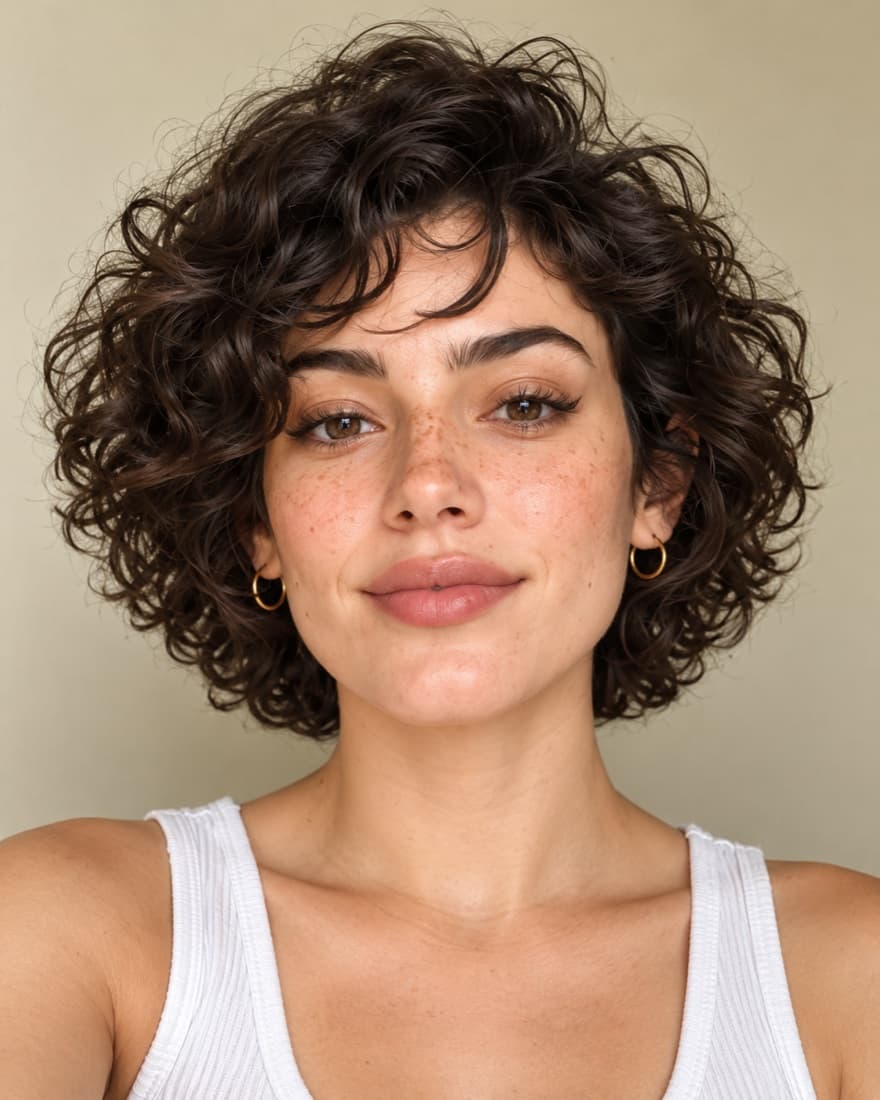
How does the FaceTwin face shape detector work?
The FaceTwin face shape detector places 68 landmarks on your selfie inside your browser and measures three ratios: face length to cheekbone width, jaw width to cheekbone width, and brow width to cheekbone width, plus the angle of your jaw. Those numbers place you in one of six shapes — oval, round, square, heart, oblong or diamond. The boundaries come from measuring 1,196 frontal faces of public figures, where 52% were oval, 16.5% oblong, 10.5% round, 8.9% heart, 8.4% square and 3.8% diamond. You see every ratio next to the result, together with three haircuts and three glasses shapes that suit your shape. It is free, needs no account and the photo is never uploaded.
- Oval, round, square, heart, oblong or diamond
- Based on 3 ratios + jaw angle
- Most common: oval (52%) · rarest: diamond (3.8%)
- Haircut and glasses ideas included
How to find your face shape with this detector
- Tick the 18+ box and upload a front-facing selfie, or take one with your camera. Pull your hair back from your forehead and jaw if you can.
- Your browser finds the face and places 68 landmarks along your jaw, brows, eyes, nose and mouth.
- The detector measures your face length, cheekbone width, jaw width, brow width and jaw angle, and classifies the shape.
- Read the result card: your shape, the ratios that decided it, and haircuts and frames that balance it.
- Switch to the other tabs to see your celebrity lookalikes or the full face analysis from the same photo.
Because a phone camera at arm's length slightly exaggerates the middle of the face, take the photo from a little further away and crop it. If your result sits on a boundary, try a second photo — a face that flips between oval and oblong is simply a longer oval.
The six face shapes and how to tell them apart
| Face shape | What defines it | Share of faces we measured |
|---|---|---|
| Oval | Length about 1.4–1.5× the width, jaw slightly narrower than cheekbones, soft curves | 52% |
| Oblong | Clearly longer than wide; brow, cheeks and jaw similar in width | 16.5% |
| Round | Length close to width, widest at the cheeks, soft wide jaw | 10.5% |
| Heart | Wide brow and cheekbones tapering to a narrow chin | 8.9% |
| Square | Broad jaw almost as wide as the cheekbones, defined jaw angle | 8.4% |
| Diamond | Cheekbones clearly the widest point, narrower brow and jaw | 3.8% |
Shapes differ by gender in our data: heart-shaped faces were 16.1% of women but only 2.8% of men, while round and square faces were more common in men. See the full tables on our face shape statistics page.
What is an oval face shape?
An oval face is about one and a half times as long as it is wide, with cheekbones as the widest point and a jaw that is a little narrower and gently rounded. It is the most common shape — just over half of the faces we measured — and the most forgiving one: most haircuts, fringes and glasses frames work, so the choice comes down to hair texture and personal style. If your detector result says oval but you feel your face is long, you are probably a long oval; frames slightly wider than your cheekbones and a bit of volume at the sides keep it balanced.
How to measure your face shape by hand
You can check the result with a mirror and a soft tape measure. Measure the width across your cheekbones, the width of your jaw from one corner to the other, the width of your forehead at its widest, and the length from your hairline to the bottom of your chin. Then compare:
- Length much bigger than cheekbone width (about 1.5× or more) → oblong.
- Length and width almost equal, soft jaw → round.
- Jaw nearly as wide as the cheekbones with sharp corners → square.
- Forehead widest, chin narrow → heart.
- Cheekbones clearly widest, forehead and jaw narrower → diamond.
- None of the above, gentle taper → oval.
The detector does the same with landmarks. Because a 68-point model cannot see the hairline, it estimates forehead height from your facial thirds; a very high or low hairline can shift a borderline result.
Haircuts and glasses for every face shape
| Face shape | Haircuts to try | Glasses to try |
|---|---|---|
| Oval | Long soft layers, textured bob, curtain fringe | Wide rectangle, soft cat-eye, thin round |
| Round | Long layers below the chin, side part with volume on top | Rectangle, square with strong brow line |
| Square | Soft waves, side-swept fringe, layers from the cheekbones | Round or oval, rimless, browline |
| Heart | Chin-length bob, side-swept fringe, waves from mid-length | Bottom-heavy or aviator, light rimless |
| Oblong | Fringe or bangs, volume at the sides, shoulder length | Oversized square, deep frames, bold temples |
| Diamond | Textured fringe, chin-length volume, tucked behind the ear | Oval or rimless, cat-eye, browline |
The detector shows the recommendations for your shape right under the result. The optional full report goes further: it looks at your hair texture, colouring and all six measurements and writes suggestions for your face specifically.
Why the result is private
Most face shape tools upload your photo to a server. FaceTwin's detector runs entirely in your browser: the model loads from our site, the measurements happen on your device, and nothing about your face is sent or stored. Our analytics never record your shape or ratios. You can switch off your connection after the model has loaded and the detector still works.
Frequently asked questions
What is my face shape?
Upload a front-facing selfie above. The detector measures your face length, cheekbone, jaw and brow widths and your jaw angle, then tells you whether your face is oval, round, square, heart, oblong or diamond.
How can I tell my face shape?
Compare your face length with your cheekbone width, and your jaw and forehead widths with your cheekbones. The detector does this automatically from 68 landmarks; you can also measure by hand with a mirror and tape.
What is the most common face shape?
Oval. In our measurements of 1,196 frontal photos, 52% of faces were oval; diamond was the rarest at 3.8%.
Is the face shape detector free?
Yes. The face shape result, ratios, haircut and glasses ideas are free with no account. Only the optional personalised full report uses credits.
Is my photo uploaded?
Not for the free results. The face model runs inside your browser, so your selfie, its landmarks and its face descriptor never leave your device. Only if you choose a paid portrait or report do we upload the photo once, after a separate consent, and delete it right after generation.
Why did I get a different face shape on another photo?
Camera distance, head tilt and hair covering the jaw change the measured ratios. Borderline faces can flip between neighbouring shapes such as oval and oblong — use a straight-on photo from a little further away.
Can a face be two shapes?
Yes — many faces sit between two shapes. The detector shows the ratios so you can see how close you are to a boundary.
More from the same selfie
Last updated 2026-10-04. FaceTwin is for entertainment and is not identity recognition, medical or cosmetic advice.