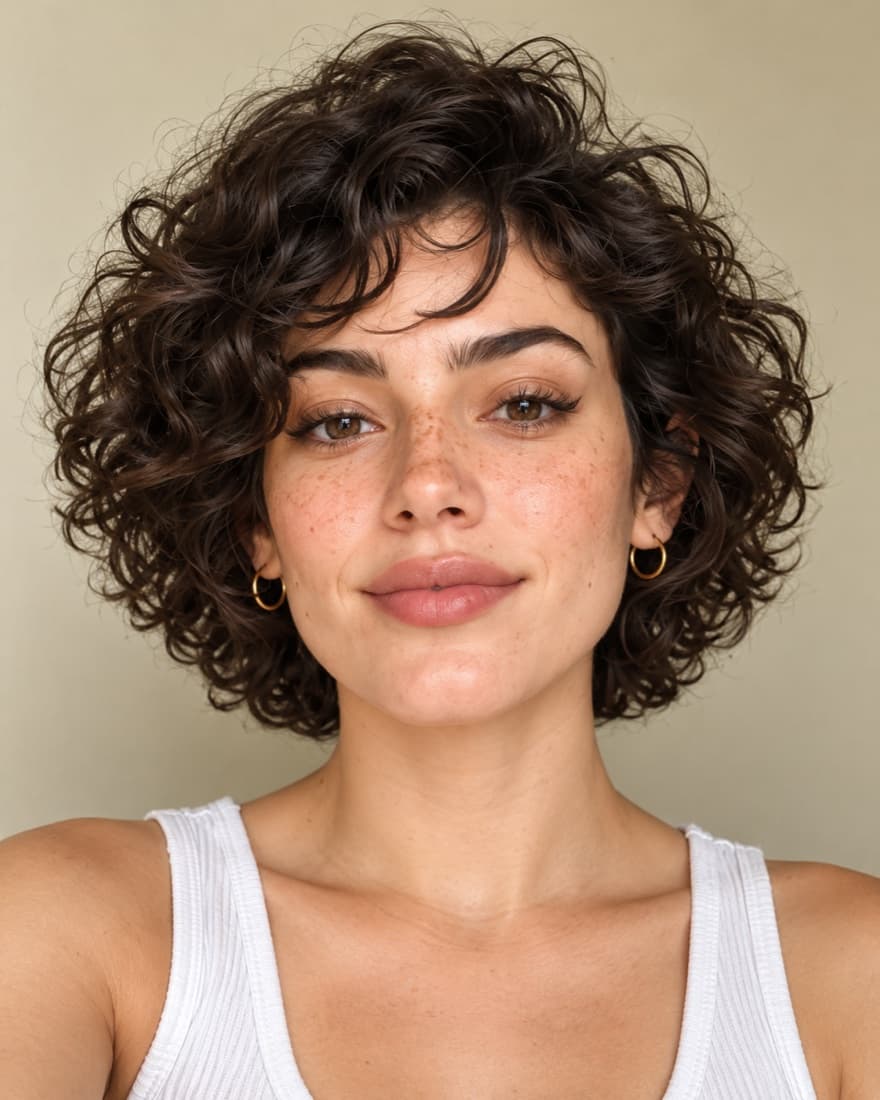
How is facial symmetry measured?
FaceTwin measures facial symmetry by placing 68 landmarks on your selfie, levelling your head, finding your facial midline and mirroring 26 left/right landmark pairs — eye corners, brows, nostrils, mouth corners and the jaw outline — across it. The distance between each point and its mirrored partner, relative to your eye spacing, becomes a symmetry percentage, plus separate scores for five regions. In our reference set of 1,196 faces the median overall symmetry is 79%, the middle 80% range from 59% to 91%, and only 17% reach 90% or more (20.2% of women, 13.9% of men). Nobody is perfectly symmetric, and a perfectly mirrored face usually looks less natural, not more attractive. Head turns, uneven light and expression all lower the number, so test two or three straight-on photos.
- 26 mirrored landmark pairs
- Median symmetry 79% across 1,196 faces
- Only 17% reach 90%+
- Heat-map + mirror composites
More face measurements
How the symmetry checker works
Symmetry sounds simple — fold the face in half and compare — but a photo is never perfectly straight. FaceTwin first measures how much your head is rolled and rotates the landmarks level. It then estimates your facial midline from eight central points running from the bridge of the nose, down the nose and lips, to the chin.
- Each left-side landmark is reflected across the midline.
- We measure how far the reflection lands from its right-side partner.
- Distances are divided by your eye spacing, so face size and photo resolution do not matter.
- Errors are averaged per region and overall, then turned into scores.
Because everything is expressed relative to your own face, a small face in a large photo and a close-up give comparable results — as long as the face is straight on.
Your five region scores
Some parts of the face are naturally more symmetric than others: the nose is almost always well aligned, while the jaw outline varies a lot. To make the regions comparable, each one is scaled so that the median face in our reference set scores 80 and a perfectly mirrored region scores 100. The table shows the spread among 1,196 faces.
| Region | Landmark pairs | Bottom 10% (p10) | Median | Top 10% (p90) |
|---|---|---|---|---|
| Eyes | 6 | 56 | 80 | 94 |
| Eyebrows | 5 | 54 | 80 | 92 |
| Nose | 2 | 69 | 80 | 87 |
| Mouth | 5 | 54 | 80 | 90 |
| Jawline | 8 | 59 | 80 | 94 |
Brows and mouth have the widest spread because they move: one raised brow or a lopsided half-smile pulls the score down quickly. The nose has the narrowest spread because it sits on the midline and has only two mirrored pairs. A low region score is usually the first thing to check when your overall number surprises you — it often points to expression rather than structure.
Reading the heat-map and mirror faces
The mirror heat-map
The heat-map colours each landmark pair on your photo by its mirror error: cool colours where the two sides match closely, warm colours where they differ most. It turns a single percentage into something you can see — for example a warm patch at one mouth corner, or along one side of the jaw.
Left-left and right-right composites
The tool also builds two synthetic faces: one made from your left half and its mirror image, and one from your right half and its mirror. If the two look like different people, your face has noticeable asymmetry; if they look alike, it is highly symmetric. These composites are computed and shown only in your browser and are never uploaded.
Why perfect symmetry looks uncanny
Research on face perception generally finds that people prefer faces with fewer obvious asymmetries, which is why symmetry carries the largest weight in our proportions score. But the preference has a ceiling. Perfectly mirrored faces — like the composites above — often look flat, doll-like or slightly unsettling, because real faces always have small differences between the sides that our brains expect to see.
Small asymmetries also give a face character: a crooked smile, a brow that lifts more on one side, a slightly fuller cheek. Many well-known faces have visible asymmetries of this kind. The useful takeaway is that a score in the 70s or 80s is normal and healthy, and there is no reason to chase 100.
Which side of your face is wider?
The symmetry test also compares the width of each half of your jaw from the midline. If one half is more than 10% wider than the other, the tool tells you which; otherwise it reports neither. In our reference set:
| Wider half (subject’s own side) | Share of 1,196 faces |
|---|---|
| Left side wider | 35.6% |
| Right side wider | 29.9% |
| Neither (within 10%) | 34.4% |
Treat this result with care. Half-face width is strongly affected by slight head turns: rotating your head just a little toward one shoulder makes the far side of the jaw look narrower and the near side wider. Lighting that falls from one side can also move the jaw outline landmarks. If the wider side flips between photos, it was the camera; if it stays the same across several straight-on photos, it is more likely your face.
Tips for an accurate symmetry test
- Face the camera squarely — line your nose up with the lens and keep both ears equally visible.
- Use light from in front, such as a window, not from one side; side light darkens one half and moves its landmarks.
- Keep a relaxed, neutral expression with both brows at rest and lips closed.
- Pull hair off the jawline and forehead so both outlines are visible.
- Turn off beauty filters and mirror mode if your camera adds them, then test two or three photos.
Everything runs in your browser. Your photo, the landmarks, the heat-map and the mirror composites stay on your device.
Frequently asked questions
How do I test my face symmetry?
Upload a straight-on selfie above. FaceTwin mirrors 26 landmark pairs across your midline and gives you an overall symmetry %, five region scores, a heat-map and mirror composites.
What is a normal face symmetry score?
In our reference set of 1,196 faces the median is 79%, and the middle 80% fall between 59% and 91%. Only 17% reach 90% or more.
Is anyone’s face perfectly symmetrical?
No. Every face has small differences between the sides, and perfectly mirrored faces tend to look artificial rather than more attractive.
Why does my symmetry score change between photos?
Head turn and roll, side lighting, expression and lens distance all move landmarks. Use the same straight-on setup and compare a few photos.
Is my photo uploaded?
Not for local lookalikes or face analysis: the model runs in your browser, so your selfie, landmarks and descriptor stay on your device. AI portraits, including the first free one, and full reports send your photo through our server to the AI provider after sign-in and separate upload consent. Reports also send your numeric measurements. FaceTwin does not save the original photo; it is discarded from request memory after processing.
What do the left-left and right-right faces show?
They are built from one half of your face and its mirror image. If they look very different, the two halves of your face differ noticeably; if they look alike, your face is highly symmetric.
Can facial symmetry be improved?
Bone structure does not change, but relaxed expression, even lighting, a straight head position and grooming of brows and facial hair make photos look more balanced.
More from the same selfie
Last updated 2026-10-08. FaceTwin is for entertainment and is not identity recognition, medical or cosmetic advice.