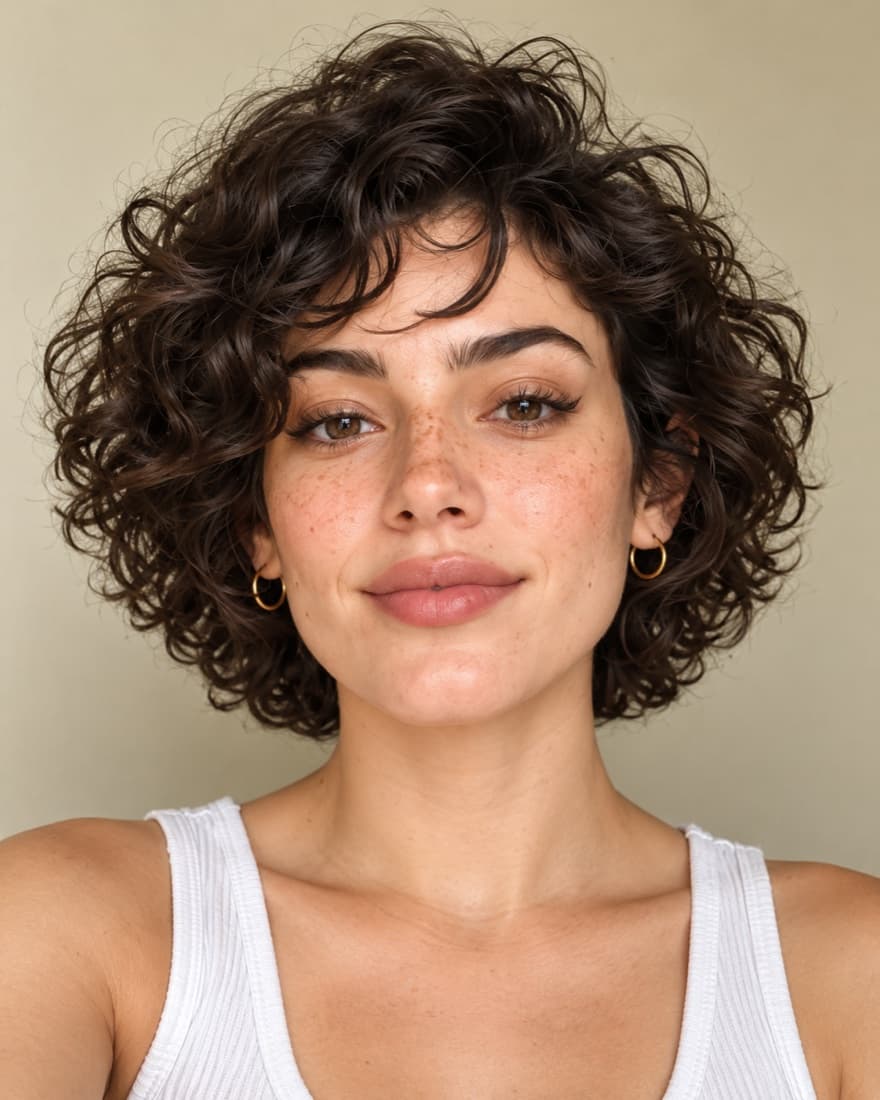
What are the types of face shapes?
Stylists usually describe seven face shapes: oval, round, square, heart, oblong (also called long or rectangular), diamond and triangle (also called pear). They differ in two things only — how long the face is compared with its width, and which of three horizontal lines is widest: the brow, the cheekbones or the jaw. An oval face is moderately long and tapers gently; a round face is almost as wide as it is long; a square face keeps its width down to a firm jaw; a heart face is broad at the top and narrow at the chin; an oblong face is long with similar widths; a diamond face peaks at the cheekbones; and a triangle face is widest at the jaw. In our reference set of 1,196 faces, oval was by far the most common at 52%, and diamond the rarest at 3.8%.
- 7 shapes: oval, round, square, heart, oblong, diamond, triangle
- Decided by length ÷ width and the widest line
- Most common: oval (52%) · rarest: diamond (3.8%)
- Many faces sit between two shapes
The seven face shapes
All seven face shapes in one table
The table below is the quickest way to compare the types of face shapes. “Key proportions” describes what you would see if you traced the outline of the face from a straight-on photo. “How common” is the share of faces in our reference set of 1,196 frontal photos of public figures (540 women, 646 men). The haircut column gives the general direction stylists aim for — the detail lives on each shape’s own page.
| Face shape | Key proportions | How common (all / women / men) | Best haircut direction |
|---|---|---|---|
| Oval | About 1.4–1.5× as long as wide; cheekbones widest; jaw a little narrower and softly curved | 52% / 50.6% / 53.4% | Almost anything; choose by hair texture |
| Oblong | Clearly long; brow, cheeks and jaw close in width | 16.5% / 22% / 11.6% | Add width and shorten: fringe, side volume |
| Round | Length close to width; full cheeks; wide jaw with soft corners | 10.5% / 5.4% / 14.7% | Add height and vertical lines |
| Heart | Broad brow and cheekbones; jaw tapers to a narrower chin | 8.9% / 16.1% / 2.8% | Add fullness near the jaw, soften the brow |
| Square | Jaw nearly as wide as the cheekbones with a firm angle | 8.4% / 4.8% / 11.3% | Soften corners with texture and diagonals |
| Diamond | Cheekbones clearly widest; narrower brow and jaw | 3.8% / 1.1% / 6.2% | Fill out the brow and jaw areas |
| Triangle (pear) | Jaw wider than the brow line | 9.9% / 2% / 16.4% (tendency, overlaps others) | Build volume at the crown and temples |
The first six rows add up to 100% because our detector assigns every face to one of them. Triangle is listed as a tendency instead: a face counts when its jaw is at least 6% wider than its brow line, and those faces are also counted under their nearest main shape — most often square or round.
The two questions that separate every shape
Face-shape charts can look like seven unrelated drawings, but they all come from answering two questions about the same outline.
- How long is the face compared with its width? A median face in our set is 1.449 times as long as it is wide across the cheekbones (women 1.47, men 1.43). Clearly above that points to oblong; clearly below it, with a wide jaw, points to round.
- Which horizontal line is widest — the brow, the cheekbones or the jaw? Cheekbones widest with a gentle taper is oval, cheekbones widest with a narrow brow and jaw is diamond, a wide top is heart, and a wide bottom is triangle. When the jaw almost matches the cheekbones and the angle is firm, the face reads as square.
Everything else in a description — “soft”, “angular”, “pointed chin” — is detail on top of those two answers. That is also why hair can change how your shape looks without changing the shape itself: a fringe shortens the visible length, and volume at the sides changes which line looks widest.
How to measure your face shape
You can work out your face shape with nothing more than a mirror, or let a selfie do the measuring. Both approaches compare the same four lines.
With a mirror and a soft tape measure
- Pull your hair back completely and stand square to the mirror in even light.
- Brow line: measure across the forehead between the outer ends of your eyebrows.
- Cheekbones: measure across the widest point, just below the outer corners of the eyes.
- Jaw: measure from one jaw corner (below the ear) to the other.
- Length: measure from the hairline at the center of the forehead to the bottom of the chin.
- Divide length by cheekbone width, then note which of the three widths is largest and by how much.
A washable marker on the mirror works too: trace your outline while keeping one eye closed, step back and look at the drawing. The trace is often more honest than a tape, because it shows the curve of the jaw as well as its width.
With the free face shape detector
The tool above does the same comparison from 68 landmarks placed on your photo, entirely inside your browser. It reports length ÷ cheekbone width, jaw ÷ cheekbone width, brow ÷ cheekbone width and your jaw angle, then names the nearest of six shapes. One limitation is worth knowing: the 68-point model has no hairline point, so forehead height is estimated from your facial proportions. A very high or low hairline can therefore nudge a borderline result. The step-by-step guide to the tool itself is on the face shape detector page.
Why face shapes overlap
Real faces do not come in seven boxes. The ratios behind them are continuous, so a face can sit right on the line between oval and oblong, or between square and round, and two good photos of the same person can land on different sides of it. Our boundaries are drawn where they are because they split a large reference set sensibly — not because nature draws a line there.
- Neighbors blur: oval ↔ oblong (length), oval ↔ round (width), round ↔ square (jaw angle), heart ↔ diamond (brow width).
- Pose matters: tilting the chin down shortens the face, and a slight head turn narrows one side of the jaw.
- Lens distance matters: a phone held close exaggerates the middle of the face; a photo from further away is more accurate.
- Soft tissue changes: weight, age and even water retention can change how the jaw and cheeks read, while the bone structure stays the same.
So treat your shape as “closest match” rather than identity. If you sit between two shapes, read both pages — advice that suits both will almost certainly suit you.
Face shapes in women and men
The split between shapes is noticeably different by gender in our data. Heart-shaped faces were 16.1% of the women but only 2.8% of the men, and oblong faces were also more common among women (22% vs 11.6%). The men leaned toward wider lower faces: round (14.7% vs 5.4%), square (11.3% vs 4.8%) and the triangle tendency (16.4% vs 2%). Oval was the most common shape for both, at roughly half of each group.
None of this makes one shape better than another. A face shape is a description of an outline, useful for choosing a haircut or a pair of frames — it says nothing about attractiveness or worth. Our face shape statistics page has the full tables if you want the detail.
Frequently asked questions
How many face shapes are there?
Most guides use seven: oval, round, square, heart, oblong, diamond and triangle. Some add “rectangle” as a separate name, but it is the same idea as oblong — a long face with similar widths.
What is the most common face shape?
Oval. In our reference set of 1,196 faces, 52% were oval, followed by oblong at 16.5%. The rarest was diamond at 3.8%.
What is the rarest face shape?
Diamond, at 3.8% of the faces we measured — and only 1.1% of the women. Cheekbones have to be clearly wider than both the brow and the jaw at the same time, which is an unusual combination.
Can my face shape change?
Your bone structure stays largely the same in adulthood, but soft tissue changes with weight and age, which can move a borderline face from one shape to a neighbor, for example from oval toward round.
Is one face shape more attractive than the others?
No. Face shapes are a vocabulary for haircuts and glasses, not a ranking. Every shape includes faces people find striking, and any score you see online is entertainment, not a measure of worth.
Why is triangle not a result in the detector?
The detector picks from six main shapes. Faces whose jaw is at least 6% wider than the brow line show a triangle tendency, and you can spot it from the jaw and brow ratios the result card displays.
Is my photo uploaded?
Not for local lookalikes or face analysis: the model runs in your browser, so your selfie, landmarks and descriptor stay on your device. AI portraits, including the first free one, and full reports send your photo through our server to the AI provider after sign-in and separate upload consent. Reports also send your numeric measurements. FaceTwin does not save the original photo; it is discarded from request memory after processing.
More from the same selfie
Last updated 2026-10-08. FaceTwin is for entertainment and is not identity recognition, medical or cosmetic advice.