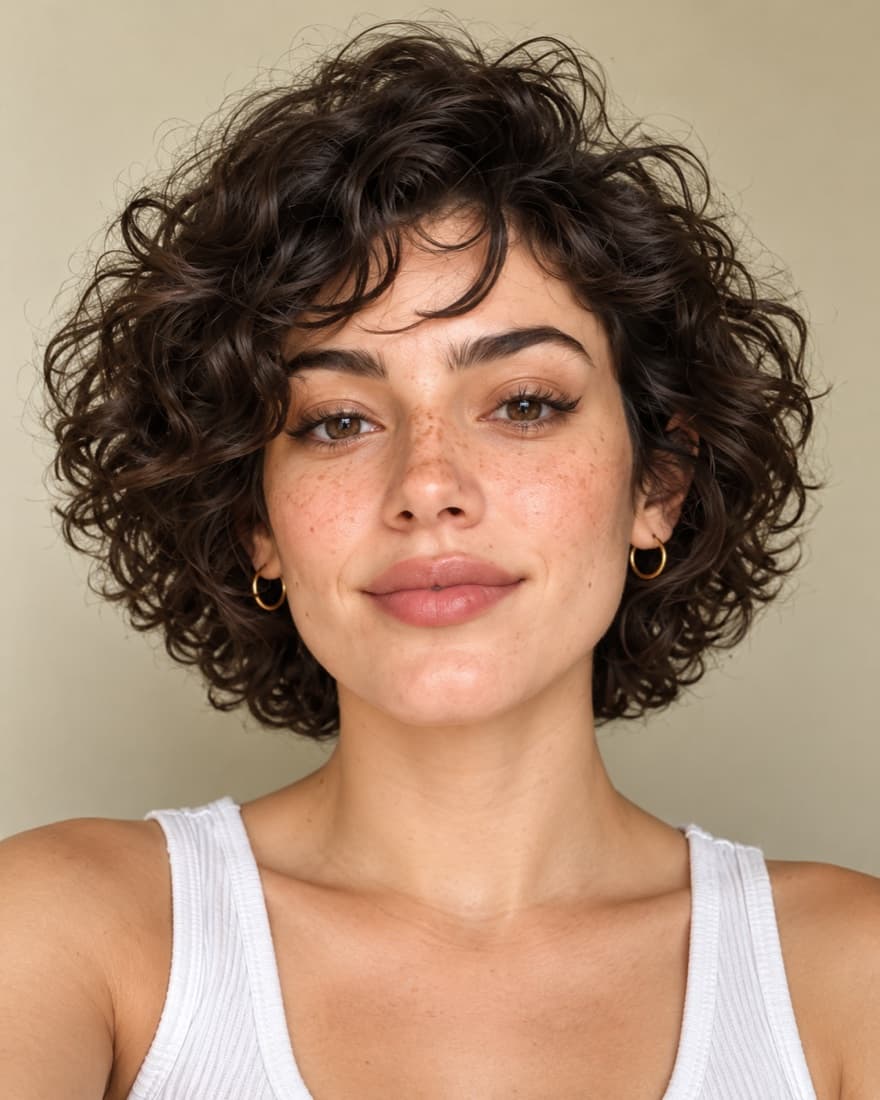
How does FaceTwin find your celebrity look alike?
Short answer: FaceTwin compares your selfie with 2,333 public figures and shows the five closest faces with a percentage match and the traits you share. The matching runs in your browser, so the photo is never uploaded; it is free, needs no sign-up and has no ads. It is for fun, not identity recognition.
FaceTwin finds your celebrity look alike by turning your selfie into a 128-number face descriptor inside your browser and comparing it with descriptors of 2,333 actors, musicians, athletes and other public figures whose freely licensed portraits are on Wikimedia Commons. It returns the five closest faces with a similarity percentage — a typical best match scores around 80%, a striking one over 90% — plus one sentence on the measured traits you share, such as face shape, eye tilt, brow arch or jaw angle. Your photo is never uploaded, the search takes under a second once the model is cached, and it is free with no account. Matches reflect facial proportions rather than hair or makeup, so try two or three photos: the celebrity who keeps reappearing is your most reliable twin.
- 2,333 public figures, Wikimedia Commons photos (CC / public domain)
- Top 5 matches with a similarity % and shared traits
- Runs on your device — no upload, no sign-up
- Typical best match ≈ 80% similar
How to use it
- Upload a selfie or take one: a front-facing, well-lit photo of yourself, no glasses, neutral expression.
- Wait a few seconds: the face model finds 68 landmarks in your browser; the photo is not uploaded.
- See your top five celebrity look-alikes with a percentage match.
- Share the card or open the other tabs for your face analysis.
Related
How the celebrity look alike finder works
Most lookalike sites ask you to upload a photo to their server and hand back a name. FaceTwin does the matching on your own phone or laptop. When you pick a selfie, a face-recognition model downloads once into your browser, finds your face, places 68 landmarks on it and turns it into a face descriptor — a list of 128 numbers that summarises the shape of your features. That descriptor is compared with descriptors we pre-computed for more than 2,300 actors, musicians, athletes and other public figures.
- Tick the 18+ box and upload a clear, front-facing selfie (or take one with your camera).
- Your browser detects the face and checks that the photo is usable — one face, not turned to the side, not too small.
- We compare your descriptor with every public figure in the index and keep the five closest.
- Each match shows a similarity percentage, one sentence on the features you share, a link to the person’s Wikipedia page and the photo’s Commons attribution.
- Switch between women, men or everyone, and share your top three as an image card.
- Have someone specific in mind? Type their name under your results to see your % with that one person and where they rank for your face.
The whole comparison takes about a second once the model is cached. Because nothing is uploaded, you can try as many photos as you like — different lighting and angles often surface different twins.
Compare yourself with a specific celebrity
People are often told they look like one particular star, and the top five may not include them. Under your results there is a name box: type any of the 2,333 public figures in the index and FaceTwin shows your similarity % with that person, the traits you share, and their rank among everyone for your face — for example “#37 of 2,333, closer than 98% of the index”. A rank in the top five means they are one of your closest matches; a rank in the hundreds means the resemblance people see is probably hair, style or expression rather than face structure.
The comparison reuses the face descriptor already computed on your device, so it is instant, works offline once the page has loaded, and sends nothing — not your photo, not the 128 numbers, not the name you typed. Only the fact that a comparison happened is counted.
| Checked Nov 2026 | FaceTwin | StarByFace | Overchat | SciMatch |
|---|---|---|---|---|
| Photo stays on your device | Yes | No (uploaded) | No (uploaded) | No (uploaded) |
| See matches without an account | Yes | Yes | No (sign-in) | Yes |
| Matches shown | Top 5 with % | Top matches with % | Top 3 with % | One “twin” plus themed results |
| Why you match | Shared measured traits | No | Feature notes | Short text |
| Compare with a celebrity you choose | Yes — % and rank | No | No | No |
What the similarity score means
The percentage is a friendly translation of the distance between two face descriptors. Two photos of the same person usually sit very close together; strangers who merely resemble each other sit a little further apart. We calibrated the scale on the index itself: a typical closest match lands around 80%, an unusually strong resemblance climbs past 90%, and anything under 70% is a loose resemblance.
It is not a measure of identity, and it is not a judgement on either face. The model reacts to proportions — the spacing of your eyes, the width of your jaw relative to your cheekbones, the length of your nose — far more than to hairstyle, makeup or skin tone. That is why your lookalike may have different hair or colouring and still be a convincing match once you look at the structure.
| Score | What it usually looks like |
|---|---|
| 90%+ | Striking resemblance — friends would do a double take |
| 80–89% | Clearly similar structure; the typical best match |
| 70–79% | Shared features, different overall impression |
| Under 70% | A loose resemblance in one or two features |
The method and the research behind it
FaceTwin uses the open-source dlib ResNet face-recognition model (run in your browser through face-api.js). Its author reports that the model was trained on about 3 million faces and turns each face into 128 numbers; on the standard Labeled Faces in the Wild (LFW) benchmark it decides whether two photos show the same person 99.38% of the time (King, 2017, dlib blog: blog.dlib.net/2017/02/high-quality-face-recognition-with-deep.html). Your similarity % is the Euclidean distance between your 128 numbers and a public figure’s, rescaled — a high % means a similar face, not the same person.
Look-alikes can share more than looks. In a 2022 study, researchers took 32 pairs of unrelated look-alikes photographed by artist François Brunelle, checked them with three face-recognition algorithms and sequenced their DNA: many of the pairs that the software rated as near-identical also shared genetic variants, while their epigenetics and microbiome differed (Joshi et al., Cell Reports 40(8), 111257, 2022; doi.org/10.1016/j.celrep.2022.111257). It is a small, early study, so treat it as a fun hint, not proof that your celebrity twin is a relative.
The counts shown under your result — today’s most-matched celebrity and how many other people matched the same person — come from anonymous top-match names only, never photos, and stay hidden until enough people have played.
Why the explanation matters
A name on its own is a bit of a party trick. FaceTwin also measures both faces with the same geometry we use for the face analysis — face shape, eye tilt, brow arch, jaw angle, lip proportion and eye spacing — and tells you which of those traits you share, for example “You share an oval face shape and arched brows.” It turns a guess into something you can see when you put the two photos side by side.
Tips for a better celebrity match
- Face the camera straight on. Turning more than about 20° to the side changes the descriptor more than anything else.
- Use soft, even light — a window in front of you is ideal. Hard shadows can hide the jaw line.
- Keep a neutral or soft expression. A wide grin changes the shape of the cheeks and mouth.
- Pull hair away from the brows and remove sunglasses; regular glasses are fine but can shift the eye landmarks.
- Try two or three photos. If one celebrity keeps coming back, that is your real twin.
Where the celebrity photos come from
We built the index from people with Wikipedia articles whose portrait on Wikimedia Commons is published under a free licence (Creative Commons, public domain and similar). For each person we keep only their name, the face descriptor and the photo attribution — not the photo itself. The small thumbnail you see next to a match is loaded straight from Wikimedia Commons, with the author and licence shown underneath.
Public figures do not endorse FaceTwin, and we never generate images of them. If you are one of the people in the index, or represent them, you can ask us to remove the entry on our takedown page and we will do so within seven days.
FaceTwin compared with typical lookalike sites
| Feature | Typical lookalike site | FaceTwin |
|---|---|---|
| Where your photo goes | Uploaded to a server | Stays on your device |
| Results | One name, sometimes a score | Top 5 with % and shared features |
| Explains the match | Rarely | Yes — face shape, eyes, brows, jaw |
| Also included | — | Free face analysis and an AI caricature |
| Price | Free with ads | Free, no ads |
The same selfie also gives you a 1–10 face analysis and, if you like, an AI caricature — you never upload the photo twice.
Frequently asked questions
Which celebrity do I look like?
Upload a front-facing selfie above. FaceTwin compares your face with 2,300+ public figures and shows your five closest matches with a similarity score and the features you share.
Is there a free celebrity lookalike finder where I can upload a selfie without signing up?
Yes — this one. Uploading a selfie, seeing all five matches and sharing the result card need no account, email or payment. The selfie is read by your browser and never sent to a server, so there is nothing to delete afterwards.
What does the similarity percentage mean?
It is how close your face descriptor is to the celebrity’s, rescaled to 0–100%. A typical best match is around 80% and a striking one is over 90%. It is not a probability and not a judgement by people — treat it as a ranking of who is geometrically closest in our 2,333-person index.
Is the celebrity look alike finder free?
Yes. Lookalikes, the face analysis and the share card are free with no account. Only AI portraits after the first one and the full styling report use credits.
Is my photo uploaded?
Not for local lookalikes or face analysis: the model runs in your browser, so your selfie, landmarks and descriptor stay on your device. AI portraits, including the first free one, and full reports send your photo through our server to the AI provider after a free first-portrait request or a credit purchase, and separate upload consent. Reports also send your numeric measurements. FaceTwin does not save the original photo; it is discarded from request memory after processing.
What model does the celebrity look alike test use?
The open-source dlib ResNet face-recognition model, run in your browser via face-api.js. It turns a face into 128 numbers and, according to its author, scores 99.38% on the LFW face-matching benchmark (King, 2017). FaceTwin compares those numbers by Euclidean distance with 2,333 public figures and rescales the distance to a %.
How accurate is it?
It uses a published face-recognition network that reliably groups photos of the same person, so the closest matches really do share facial structure. Resemblance is subjective, though — treat it as a fun, well-founded guess, not a fact.
How is FaceTwin different from other celebrity lookalike sites?
Check three things on any lookalike site: whether the photo is uploaded, how many people are in the index, and whether it explains the match. FaceTwin matches on your device against 2,333 public figures with freely licensed Commons photos, shows five matches with the traits you share, and uses the same selfie for a face shape, symmetry and golden-ratio analysis. Sites with bigger indexes can find more obscure matches; sites that upload your photo can use larger server-side models.
Can I check how much I look like one specific celebrity?
Yes. After your top five appear, type a name in the “Compare with a specific celebrity” box. You get your similarity % with that person and their rank among all 2,333 public figures for your face, so you can see whether the resemblance friends mention is in your face structure or in hair and style.
Why is the celebrity people say I look like not in my top 5?
People notice hair, glasses, smile and style; the model compares bone structure and feature proportions. Type that celebrity’s name in the compare box to see their exact rank — if they land in the top 50, the resemblance is real but others are closer; if they are in the hundreds, it is mostly styling.
Why do I get different celebrities with different photos?
Pose, lighting and expression all move the face descriptor a little. Matches that appear across several photos are your most reliable twins.
Can I compare a friend’s photo?
Please only use photos of yourself. FaceTwin is designed for adults exploring their own face, and the 18+ confirmation covers your own photo.
Why can’t I see a photo of my lookalike?
Thumbnails load from Wikimedia Commons. If your network blocks Commons, the image stays blank — the name, score and Wikipedia link still work.
More from the same selfie
Related by topic
Celebrity look alikes
The data behind the scores: FaceTwin facts · face shape statistics
Last updated 2026-10-18. FaceTwin is for entertainment and is not identity recognition, medical or cosmetic advice.