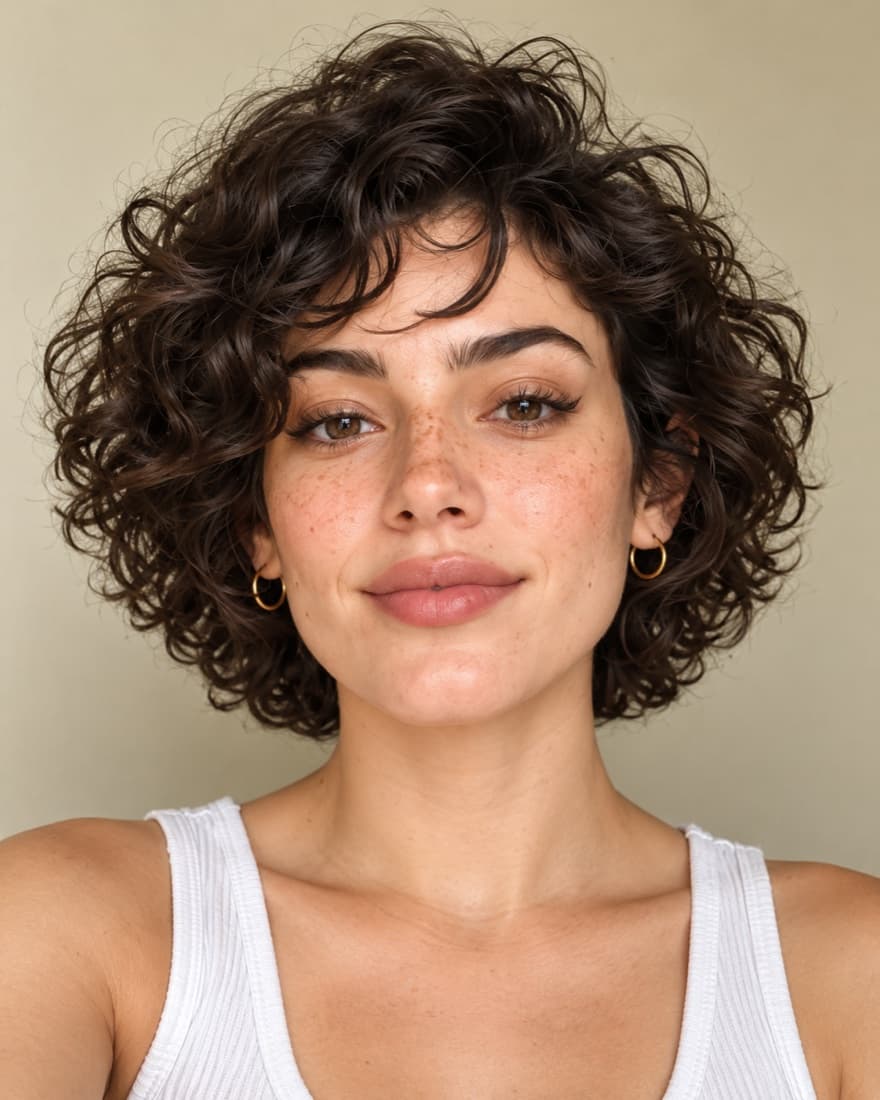
What does a face shape analyzer measure?
The FaceTwin face shape analyzer measures four things from 68 landmarks placed on your selfie in your browser: face length divided by cheekbone width, jaw width divided by cheekbone width, brow width divided by cheekbone width, and the angle at the corner of your jaw. It then applies fixed rules calibrated on our reference set of 1,196 faces. A length ratio of 1.53 or more means oblong. A jaw at least 0.833 of the cheek width with an angle of 145° or less means square. A short face (1.38 or less) with a wide jaw (0.817 or more) means round. A wide brow with a narrow jaw means heart, a narrow brow and jaw means diamond, and everything else is oval. Your result card shows all four numbers, so you can see how close you are to each boundary.
- Length ÷ cheek, jaw ÷ cheek, brow ÷ cheek
- Plus jaw angle (median 146°)
- Rules calibrated on 1,196 faces
- Every number shown on the result card
Face shape tools and guides
What the analyzer measures
Every face shape description boils down to proportions, so the analyzer measures proportions rather than guessing from an overall impression. All widths are compared with the cheekbones, which makes the numbers independent of how large your face appears in the photo.
| Measurement | Landmarks used | Reference median |
|---|---|---|
| Length ÷ cheekbone width | Estimated top of forehead to chin, against the widest cheek points | 1.449 (women 1.47, men 1.43) |
| Jaw ÷ cheekbone width | Jaw corners against the widest cheek points | Shown on your card |
| Brow ÷ cheekbone width | Outer brow ends against the widest cheek points | Shown on your card |
| Jaw angle | The angle where the jawline turns up toward the ear | 146° |
The jaw angle groups into three bands in our reference set: defined (under 141°) for 18.3% of faces, balanced for 63.2%, and soft (over 150°) for 18.5%.
The decision rules, in order
The analyzer checks the rules from top to bottom and stops at the first one that fits. The thresholds are quantiles from 1,196 frontal photos of public figures (540 women, 646 men), chosen so each shape matches how stylists describe it.
| Order | Shape | Rule | Share of reference faces |
|---|---|---|---|
| 1 | Oblong | Length ÷ cheek width ≥ 1.53 | 16.5% |
| 2 | Square | Jaw ÷ cheek ≥ 0.833 and jaw angle ≤ 145° | 8.4% |
| 3 | Round | Length ÷ width ≤ 1.38 and jaw ÷ cheek ≥ 0.817 | 10.5% |
| 4 | Heart | Brow ÷ cheek ≥ 0.83 and jaw ÷ cheek ≤ 0.82 | 8.9% |
| 5 | Diamond | Brow ÷ cheek ≤ 0.797 and jaw ÷ cheek ≤ 0.822 | 3.8% |
| 6 | Oval | None of the above | 52% |
There is no separate triangle result. Faces whose jaw is at least 6% wider than the brow line — 9.9% of our reference set — are reported as their nearest shape, often square or round, and you can spot the tendency by comparing your jaw and brow ratios.
How to read your result card
The label at the top is the first rule your numbers satisfied. The four values underneath tell you why, and how firmly.
Length ÷ cheekbone width
This is the single biggest driver. Near the 1.449 median you are in typical oval territory; at 1.53 or above the face reads as long, and at 1.38 or below it reads as short and wide. A value just under 1.53 means you are a long oval rather than oblong.
Jaw ÷ cheekbone width
Higher means a broader lower face. Around 0.82–0.83 is where round and square begin; noticeably lower values mean the face tapers toward the chin, which is what heart and diamond faces share.
Brow ÷ cheekbone width
This separates the two tapering shapes. A brow at 0.83 or more of the cheek width points to heart; 0.797 or less points to diamond. Compare it with your jaw ratio too: if the jaw is clearly wider than the brow, you have a triangle tendency.
Jaw angle
Smaller angles mean a sharper corner. It only decides between square and other shapes, but it is useful on its own: under 141° counts as defined, over 150° as soft.
Borderline results and how to resolve them
Because the rules use sharp thresholds, a face just either side of one can switch labels between photos. That does not mean the analyzer is broken; it means your face sits between two shapes. To settle it:
- Look at the number nearest a threshold. If length ÷ width reads 1.52, you are a long oval that borders oblong.
- Take a second photo from a little further away, with the camera at eye level and your chin level.
- Pull hair fully back so the jaw corners and brow ends are visible.
- If two photos still disagree, accept both labels and read the advice for each — styling that suits both will suit you.
Accuracy limits worth knowing
- Hairline: the 68-point landmark model has no hairline point, so forehead height — and therefore face length — is estimated from your other proportions. A very high or low hairline can shift the length ratio.
- Hair volume: the analyzer measures your face, not your silhouette. Big hair can make a face look rounder to the eye while the numbers stay the same, and hair over the jaw can hide the corners it needs.
- Camera distance: a phone held close enlarges the middle of the face, which tends to lower the length ratio. Shooting from further away and cropping gives truer proportions.
- Head pose: a chin tilted down shortens the face, and a turned head narrows one side of the jaw.
- Expression: a wide smile lifts and widens the cheeks, so a neutral face is more repeatable.
Manual measuring vs photo analysis
| Tape and mirror | Photo analyzer | |
|---|---|---|
| What you need | Soft tape, mirror, a few minutes | One selfie |
| Hairline | Measured directly | Estimated |
| Jaw angle | Hard to measure | Measured in degrees |
| Repeatability | Depends on where you place the tape | Same landmarks every time |
| Main error source | Soft tissue and tape placement | Pose, lens distance, hair |
The two methods complement each other. If they agree, you can be confident. If they disagree, the tape is better for face length and the analyzer is better for the jaw. The step-by-step manual method is on our guide to finding your face shape.
Frequently asked questions
How accurate is an AI face shape analyzer?
It is consistent: the same landmarks and rules are applied every time. Accuracy depends on the photo — straight-on, level camera, hair pulled back — and on the hairline, which is estimated rather than seen.
What ratios decide my face shape?
Face length ÷ cheekbone width, jaw ÷ cheekbone width and brow ÷ cheekbone width, plus your jaw angle. The rules table on this page lists the exact thresholds.
Is my photo uploaded?
Not for local lookalikes or face analysis: the model runs in your browser, so your selfie, landmarks and descriptor stay on your device. AI portraits, including the first free one, and full reports send your photo through our server to the AI provider after sign-in and separate upload consent. Reports also send your numeric measurements. FaceTwin does not save the original photo; it is discarded from request memory after processing.
Why does the analyzer say oval when my face looks long?
Oblong starts at a length ratio of 1.53. If you are just under it, you are a long oval. Check the number on your card to see how close you are.
Does the analyzer detect triangle face shapes?
Not as a separate label. Faces with a jaw at least 6% wider than the brow are reported as their nearest shape; compare your jaw and brow ratios to spot the tendency.
What is a normal jaw angle?
The median in our reference set of 1,196 faces is 146°. Under 141° is defined and over 150° is soft; most faces sit in between.
Is face shape analysis free?
Yes. The shape, all four measurements and the haircut and glasses ideas are free with no account.
More from the same selfie
Last updated 2026-10-08. FaceTwin is for entertainment and is not identity recognition, medical or cosmetic advice.