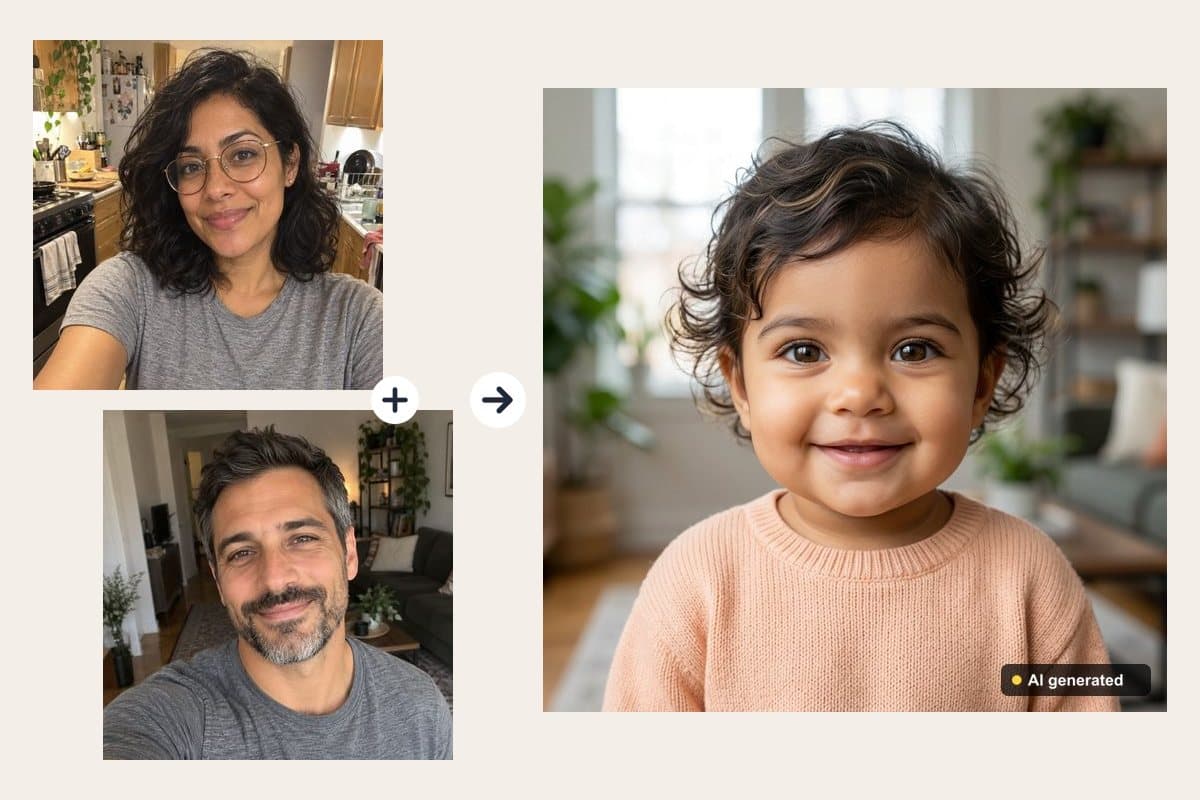
How does an AI baby generator work?
Short answer: To see what your baby might look like, pick baby girl, baby boy or a girl or boy of about 5, then upload one clear photo of each parent to FaceTwin. A safety check blocks children, nudity and public figures; the AI blends both faces into one imagined child in about 15 seconds. First one free, labelled “AI generated”, deleted within 24 hours.
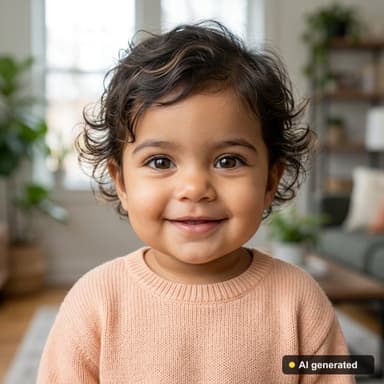
An AI baby generator takes a photo of each parent and asks an image model to draw a child who could plausibly be theirs. On FaceTwin you choose a baby girl, a baby boy, or a girl or boy of about five, tick the consent box and upload one clear photo of each adult. A safety check looks at both photos first and refuses children, nudity and recognisable public figures, before anything is made or charged. The model then blends visible features from both faces — face shape, eye shape and colour, nose, lips, brows, hair and a skin tone between the two — into one photorealistic, fully clothed portrait in about 15 seconds. It is an imagined child, not a genetic prediction: real children inherit hidden traits a photo can’t show. Every image carries an “AI generated” label and is deleted within 24 hours.
- 2 parent photos, about 15 seconds
- Baby girl, baby boy, girl or boy age 5
- First result free; then $1.99 or 5 for $4.99
- “AI generated” label; deleted within 24 h
More from your photos
See your future baby in three steps
- Pick the child: baby girl or baby boy (about 1 year old), or a girl or boy of about 5.
- Tick the consent box, then upload a clear photo of parent 1 and a clear photo of parent 2 — one adult per photo, facing the camera.
- Your child appears in about 15 seconds. Download it, or press Delete now. The first one is free in HD; after that, pick another gender or age for $1.99, or get five for $4.99.
No account, no app and no e-mail for the first one. The same two photos work for every option, so you can see a baby and a five-year-old, or a girl and a boy, side by side without uploading again.
What the AI takes from each parent
The image model looks at both faces and mixes what it can see. It doesn’t copy one parent and shrink them; it is told to make a new, fictional child with features from both.
| Feature | What the AI does | What a photo can’t tell it |
|---|---|---|
| Face shape | Blends the outline of both faces, softened for a child’s rounder cheeks | How the jaw and nose change as a child grows |
| Eyes | Mixes eye shape, and picks a colour from what both parents show | Recessive colours — two brown-eyed parents can have a blue-eyed child |
| Hair | Mixes colour and texture — straight, wavy or curly | Hair that darkens or changes with age, and baby hair that falls out |
| Skin tone | Chooses a tone that sits naturally between the two photos | Real variation between siblings, and how lighting changed the photos |
| Nose, lips, brows | Takes shapes from either parent, scaled to a child | Features that skip a generation and come from grandparents |
That is why the result is a fun “what if”, not a forecast. Run it twice and you will get two different, equally plausible children — just as real siblings look different from each other.
Getting a better baby picture
- Use front-facing photos with the whole face visible — no sunglasses, masks, heavy filters or hands near the face.
- Soft, even daylight on both photos helps the AI read skin tone and eye colour correctly. A dim photo makes everything look darker.
- One person per photo. Crop a group shot down to one face before you upload it.
- Similar photos give a fairer mix: if one parent is a sharp close-up and the other a tiny face in a wide shot, the clearer face tends to win.
- Recent photos work best. An old or heavily edited photo shows the AI a face that isn’t quite yours.
Rules built into the tool
Making a baby picture with your partner is sweet. Using a stranger’s or a celebrity’s face is not, so the rules are in the product, not only on this page:
| Allowed | Not allowed (blocked or removed) |
|---|---|
| You and your partner, or two adult friends who agreed | Photos of people who didn’t agree, or strangers from social media |
| A gender reveal, baby shower or anniversary card idea | Celebrities, politicians and other public figures — blocked when detected |
| Sharing the result with the label on | Photos of children as a parent — the safety check blocks anyone who may be under 18 |
| Fun, clearly marked AI pictures | Nudity or sexual content of any kind — blocked |
- Consent first: you confirm you are 18+ and that both adults agreed. Without that tick, nothing is sent.
- Safety check on both photos before anything is made: children, nudity and recognisable public figures are refused, and nothing is charged.
- Visible “AI generated” label burned into every result, including the free one. Please don’t crop it off.
- Deleted within 24 hours: your two photos are never stored, and the result is removed automatically. Delete now removes it at once, and Report misuse under the result reaches us directly.
- The child is always fictional, fully clothed and shown alone in a simple family-photo style.
Baby generator or celebrity parents?
They answer opposite questions. The baby generator looks forward: two parents in, an imagined child out, made by an AI image model on our server after you agree. The celebrity parents generator looks back: one selfie in, the celebrity “mom” and “dad” whose faces are closest to yours, matched entirely in your browser with no upload and no cost.
| AI baby generator | Celebrity parents generator | |
|---|---|---|
| You upload | Two photos, one per parent | One selfie |
| You get | One imagined child: baby or age 5, girl or boy | Top 3 celebrity moms and dads, with % match |
| Where it runs | AI image model, after consent; deleted within 24 h | In your browser; the photo never leaves the device |
| Price | First one free, then $1.99 | Free |
Privacy: what happens to your photos
Your two photos are sent through FaceTwin’s server to the AI image provider only after you tick the consent box. They are used once in memory to run the safety check and make the picture, then discarded — FaceTwin does not save them and does not use them for training. The result is kept in private storage behind a link only you get, and deleted within 24 hours.
Frequently asked questions
Is an AI baby generator accurate?
No tool can predict what a real child will look like. Genes mix in ways a photo can’t show — recessive eye and hair colours, features from grandparents, and plain chance. FaceTwin’s AI blends visible features from both photos into a plausible child, which is fun to look at, not a forecast. Treat it as entertainment.
Is the baby generator free?
The first result is free in full HD with no account and no watermark, one per browser while the daily free quota lasts. After that each child costs 10 credits: $1.99 gets 20 credits (two more children), or $4.99 gets 50 (five). Credits are one-time — no subscription.
Can I choose a boy or a girl, and the age?
Yes. Pick a baby girl or baby boy of about one year, or a girl or boy of about five, before you upload. After your first result you can try the other options with the same two photos.
Can I use a celebrity as the other parent?
No. The safety check refuses recognisable celebrities, politicians and other public figures. Both photos must be of adults who agreed — you and your partner, or friends who said yes.
How long do you keep the baby picture?
Your uploaded photos are not stored at all. The result is deleted automatically within 24 hours, and the Delete now button under it removes it at once. Download it first if you want to keep it.
Is my photo uploaded?
Not for local lookalikes or face analysis: the model runs in your browser, so your selfie, landmarks and descriptor stay on your device. AI portraits, including the first free one, and full reports send your photo through our server to the AI provider after a free first-portrait request or a credit purchase, and separate upload consent. Reports also send your numeric measurements. FaceTwin does not save the original photo; it is discarded from request memory after processing.
More from the same selfie
Related by topic
Headshots and profile pictures
The data behind the scores: FaceTwin facts · face shape statistics
Last updated 2026-10-18. FaceTwin is for entertainment and is not identity recognition, medical or cosmetic advice.