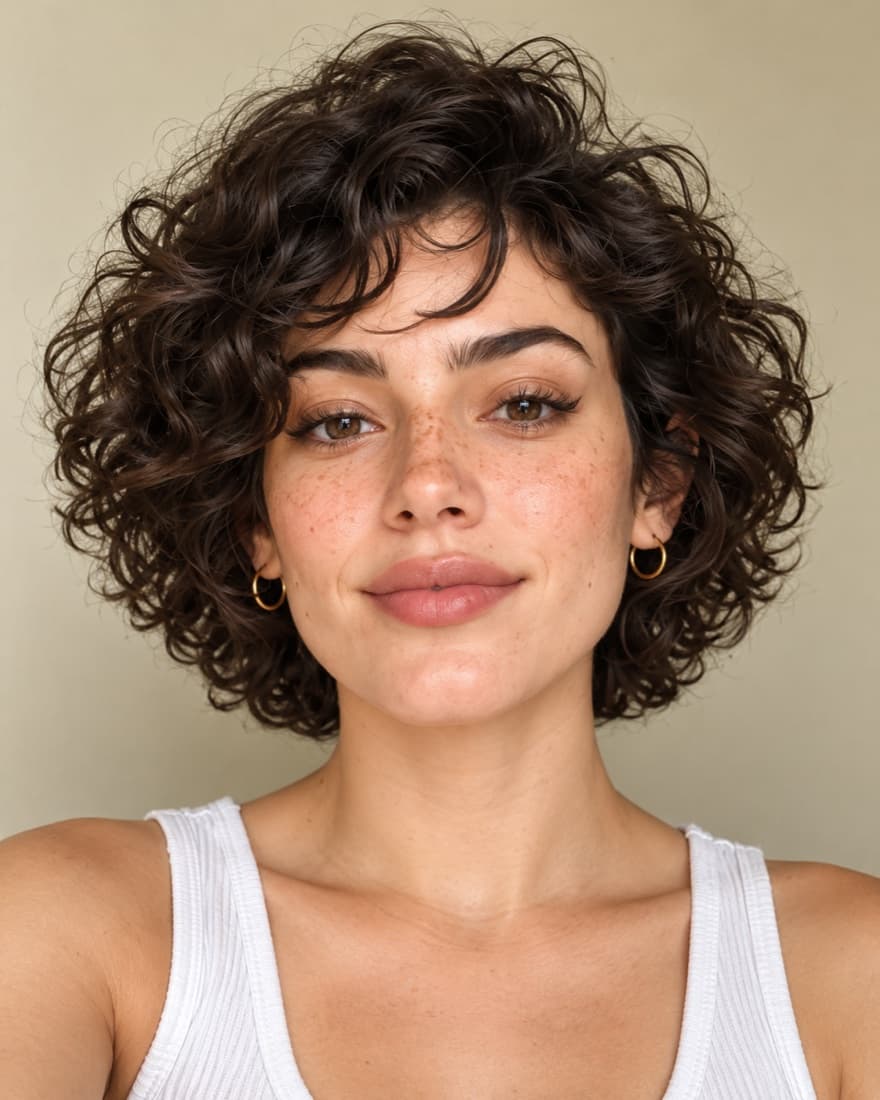
How can you tell what eye shape you have?
Eye shape comes from two things you can measure: how open the eye is, and which way its outer corner points. FaceTwin measures both from 68 landmarks in your browser. Openness is the eyelid opening divided by eye width, averaged over both eyes; we call it narrow below 0.283, medium up to 0.312 and open above that, which are the quartiles of our 1,196 reference faces. Tilt is the canthal tilt: positive when the outer corner sits higher than the inner corner, neutral when level, negative when lower. Combining three openness bands with three tilts gives nine labels, from fox and upturned almond to almond, round, downturned and doe. Almond is the most common label (37.6% of reference faces). Hooded lids and monolids are not detected. The photo is never uploaded.
- 9 labels: 3 openness bands × 3 tilts
- Almond is most common: 37.6%
- Cut-offs 0.283 / 0.312 = reference quartiles
- Hooded and monolid not detected
Related eye tools
The nine eye shapes and how FaceTwin classifies them
Online eye shape charts mix names for lid type (hooded, monolid), spacing (wide set, close set) and outline (almond, round). We separate them. This test names the outline of the open eye using two numbers, and treats spacing in its own calculator. The table shows every label, the rule that produces it, and how many of our 1,196 reference faces received it.
| Label | Openness (height ÷ width) | Canthal tilt | Share of 1,196 faces |
|---|---|---|---|
| Fox | Narrow (under 0.283) | Positive | 3.6% |
| Upturned almond | Medium (0.283–0.312) | Positive | 10.5% |
| Upturned round | Open (over 0.312) | Positive | 6.4% |
| Elongated almond | Narrow (under 0.283) | Neutral | 15.6% |
| Almond | Medium (0.283–0.312) | Neutral | 37.6% |
| Round | Open (over 0.312) | Neutral | 17% |
| Downturned almond | Narrow (under 0.283) | Negative | 4.3% |
| Downturned | Medium (0.283–0.312) | Negative | 4.5% |
| Doe | Open (over 0.312) | Negative | 0.6% |
Openness cut-offs are 0.283 and 0.312, the first and third quartiles of eye openness in the reference set (median 0.298). That means about a quarter of faces fall in the narrow band and a quarter in the open band, whatever the camera. Tilt uses the same positive / neutral / negative call as the canthal tilt calculator.
Fox, siren, almond, doe, round: what the names mean
Beauty and makeup writers use these words loosely. Here is what each means in this test, and the plain description the tool shows.
| Common name | In this test | Description |
|---|---|---|
| Fox eyes / siren eyes | Fox (narrow, positive tilt) | Narrow and lifted at the outer corner |
| Upturned eyes | Upturned almond or upturned round | Outer corners higher than the inner ones; almond when medium, round when open |
| Almond eyes | Almond | Balanced openness with level corners; the most common label |
| Elongated almond | Elongated almond | Long, fairly narrow almond eyes on a level axis |
| Round eyes | Round | More visible height than most, on a level axis |
| Downturned eyes | Downturned almond or downturned | Outer corners slightly lower than the inner ones |
| Doe eyes | Doe | Large, open eyes with soft, slightly lowered outer corners |
Our reference set is public figures photographed for portraits, so the shares describe that group. Within it, almond (37.6%) and round (17%) are the biggest labels, upturned almond is 10.5%, and doe is rare at 0.6%. Fox is 3.6%. Men and women differ: elongated almond is 22.1% of men against 7.8% of women, while upturned round is 11.3% of women against 2.3% of men.
What this test cannot see
Two eye features that appear on many eye-shape charts are not detected here, and we would rather say so than guess.
- Hooded eyes: a fold of skin from the brow bone that covers part of the lid. The 68-point landmark model has no point on the lid crease, so this cannot be measured reliably.
- Monolids: eyes without a visible crease. Same limit.
- Eyelid colour, lashes and makeup: not measured.
Because of that, a person with a hooded or monolid eye still gets one of the nine outline labels, based on the opening they have. The label describes the visible opening in this photo, not the lid structure. The disclaimer under the result repeats this.
Expression matters too. Squinting, a broad smile or raised brows change the opening within a second. For a fair reading use a relaxed face and the camera at eye level, and test two photos. If the label changes between them, you are near a cut-off and either label fits.
Entertainment, not a measure of worth. For adults, using your own photo.
From eye shape to the rest of the eye area
The panel shows three numbers together: openness, canthal tilt and eye spacing. Each answers a different question and each has its own page.
- Openness and tilt together name the shape (this page).
- Spacing, the eye separation ratio, says wide set or close set (eye spacing calculator).
- Tilt on its own, in degrees, with a positive / neutral / negative call (canthal tilt calculator). In our reference set 20.5% of faces are positive, 70.2% neutral and 9.4% negative.
Makeup artists use eye shape to choose liner and lash styles, and glasses fitters use it to choose frames. For those uses the nine labels are a starting point: try the style, and judge it in the mirror.
Hunter eyes, a term from looksmaxxing forums, usually means a combination of positive tilt, narrow openness and low brows. It is not a label we compute; the hunter eyes page explains what the measurements can and cannot say about it.
Frequently asked questions
What eye shape do I have?
Upload a relaxed, straight-on photo. The test measures how open your eyes are and which way the outer corners point, then names one of nine shapes. The most common is almond.
How does FaceTwin classify eye shapes?
It combines three openness bands (narrow under 0.283, medium 0.283–0.312, open above) with three canthal tilts (positive, neutral, negative). The cut-offs are the quartiles of eye openness in our 1,196 reference faces.
Does the test detect hooded eyes or monolids?
No. The 68 landmarks do not include the lid crease, so hooded eyes and monolids cannot be detected. You still get an outline label based on the visible opening.
What are fox eyes and siren eyes?
In this test, fox is the narrow-and-lifted shape: openness under 0.283 with a positive canthal tilt. Siren eyes is a similar popular name. It is 3.6% of our reference faces.
Why did my eye shape change between photos?
Eye openness changes with squinting, smiling and camera height. If you are close to a cut-off, either neighbouring label fits. Test two relaxed photos.
Are doe eyes rare?
In our reference set doe is the rarest label at 0.6%. It requires open eyes and a negative canthal tilt together.
Is my photo uploaded?
Not for local lookalikes or face analysis: the model runs in your browser, so your selfie, landmarks and descriptor stay on your device. AI portraits, including the first free one, and full reports send your photo through our server to the AI provider after a free first-portrait request or a credit purchase, and separate upload consent. Reports also send your numeric measurements. FaceTwin does not save the original photo; it is discarded from request memory after processing.
More from the same selfie
Related by topic
Eyes and canthal tilt
The data behind the scores: FaceTwin facts · face shape statistics
Last updated 2026-10-18. FaceTwin is for entertainment and is not identity recognition, medical or cosmetic advice.