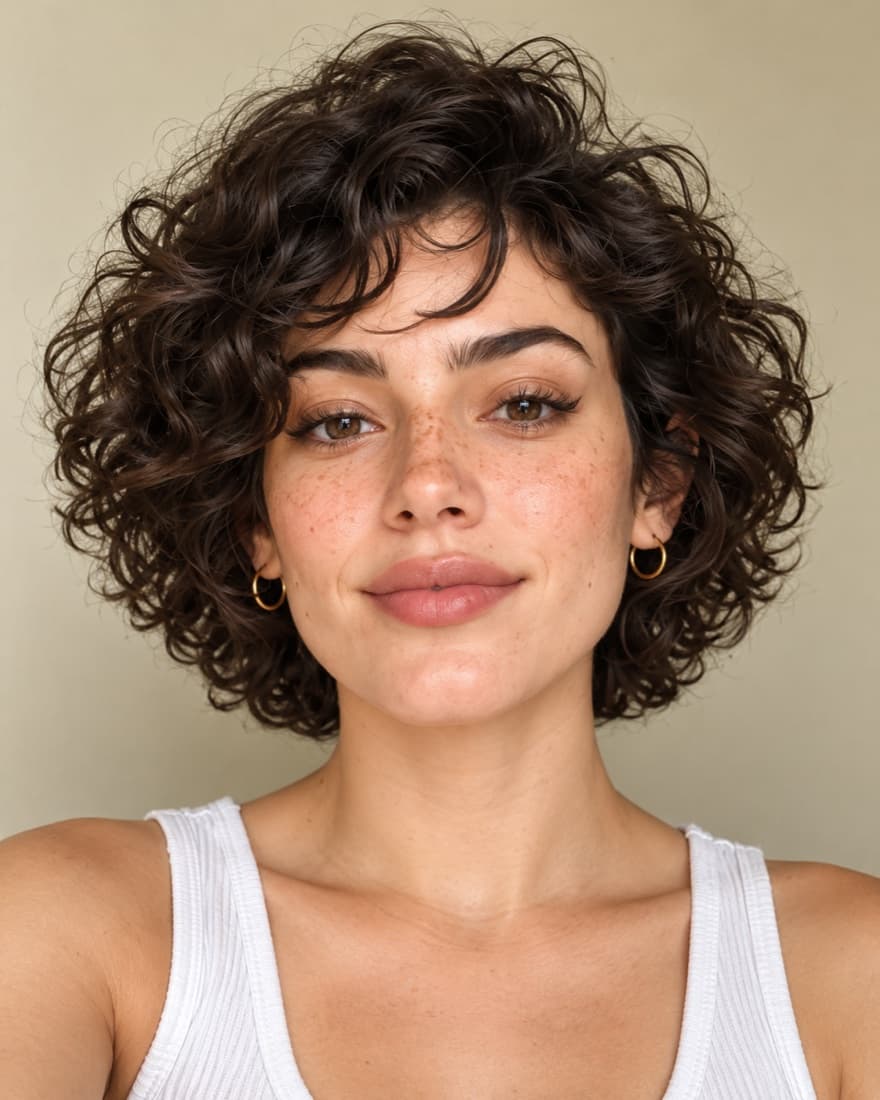
How do you know if your eyes are wide set or close set?
Measure the distance between your pupils and divide it by your cheekbone width: the result is the eye separation ratio (ESR). FaceTwin does this from 68 landmarks in your browser. In our reference set of 1,196 faces the median ESR is 0.452 (women 0.462, men 0.445), and the middle half of faces fall between 0.441 and 0.463. We call eyes wide set above 0.463, close set below 0.441, and average in between. These are comparisons with a reference group, not medical categories, and other tools use different definitions such as inner-corner distance, so compare your result only with ranges from the same method. Take the photo straight on, at eye level, with a relaxed face, because head turn and a downward gaze both change the pupil distance. Everything runs in your browser and the photo never leaves your device.
- Median ESR 0.452 in 1,196 faces
- Average-set: 0.441–0.463
- Pupil distance ÷ cheekbone width
- No upload, no sign-up
Related measurements
How eye spacing is measured
There are three common ways to talk about the distance between the eyes, and they are often mixed up. Any of them can be used for a wide-set or close-set test, but the numbers are not interchangeable.
| Measure | What is measured | Used by | In FaceTwin |
|---|---|---|---|
| Interpupillary distance (IPD) | Pupil centre to pupil centre, in millimetres | Opticians, glasses | Not in mm: a selfie has no scale |
| Intercanthal distance | Inner corner to inner corner | Medical texts, fifths rule | Shown as the gap in the fifths calculator (median gap 26.9% of face width) |
| Eye separation ratio (ESR) | Pupil distance ÷ cheekbone width | Looksmaxxing tools, face analysis | Yes: median 0.452 |
FaceTwin uses the ESR because a ratio does not need a scale: it works on any photo from any distance, as long as the face is straight on. The pupil centres come from the eyelid landmarks of each eye, and the cheekbone width is the same one used for FWHR.
Wide set, close set or average: the ranges from 1,196 faces
The call is made against the reference set, not against a fixed number. Eyes read as wide set when the ESR is above the 75th percentile (0.463), close set when it is below the 25th (0.441), and average between them.
| Group | 10th pct | 25th pct | Median | 75th pct | 90th pct |
|---|---|---|---|---|---|
| Everyone | 0.43 | 0.441 | 0.452 | 0.463 | 0.473 |
| Women | 0.444 | 0.454 | 0.462 | 0.47 | 0.477 |
| Men | 0.427 | 0.435 | 0.445 | 0.453 | 0.462 |
Women in our set have a slightly higher ESR than men (median 0.462 against 0.445), because their cheekbone width is on average a little smaller relative to eye distance. If you are near a threshold, look at the women or men row as well. Half of all faces fall in the “average” band by construction; a quarter are in each outer band, so “close set” here means closer than three quarters of the reference faces, not an unusual feature.
A related number is the intercanthal ratio, the gap between the inner corners divided by eye width. The classical rule of fifths says one eye width. In our set it is 1.619 at the median, which is why the fifths calculator explains the offset.
The wide set eyes test: what you can and can't conclude
Wide-set and close-set are impressions as much as measurements. What people notice is the gap in the middle of the face relative to the eyes, the width of the nose bridge, the brows and the head shape. A person with a high ESR can look average if the eyes are large, and a person with a low ESR can look wide-set if the nose bridge is broad.
- The ESR describes pupil spacing relative to cheekbones in your photo.
- It does not describe the bridge of the nose, brow spacing or eye size, though they influence how spacing looks.
- It does not indicate any medical condition. Hypertelorism and telecanthus are clinical diagnoses made from measurements on the person, not from a selfie.
If you have a concern about the spacing of your eyes for medical reasons, speak to a clinician. This tool is for entertainment.
Entertainment, not a measure of worth. For adults, using your own photo.
Eye spacing and the rest of the face
Eye spacing is relative: the same pupil distance looks wide on a narrow face and close on a broad one. The ESR already builds this in by dividing by cheekbone width, which is why it works better than a raw distance. It still ignores the nose bridge, the brow gap and eye size, which together decide how spacing looks to other people.
- A broad nose bridge makes eyes read as wider set than the ESR suggests.
- Large eyes make the gap between them look smaller, so the eyes can read as closer set.
- Brow shape and thickness can visually fill or open the space between the eyes.
Use the number to describe your photo, and the eye shape test to see how openness and tilt combine with it.
Photo tips that change the answer
- Face the lens squarely. Turning the head by even a few degrees shifts the pupils relative to the cheekbones.
- Look straight ahead at the camera, not at the screen below it; looking down can bring the pupils closer.
- Use arm’s length or further. Close-ups enlarge the middle of the face.
- Take off glasses with heavy frames and pull hair away from the sides.
- Take two photos and compare. A change of 0.005 or more between shots is the photo, not your eyes.
The eye spacing result also appears in the eye shape test, next to openness and canthal tilt, because spacing and shape together make up how the eye area looks.
Frequently asked questions
What is the eye separation ratio?
It is the distance between the two pupils divided by the width of the face at the cheekbones. Because it is a ratio, it does not need a scale and works on a selfie from any distance.
What is a normal eye spacing?
In our 1,196-face reference set the median ESR is 0.452 and the middle half lie between 0.441 and 0.463. Values in that band count as average-set.
How do I know if I have close set eyes?
If your ESR is below 0.441, the eyes sit closer together than three quarters of the reference faces and FaceTwin labels them close set. Retake the photo straight on before you trust a borderline result.
Is this the same as interpupillary distance (IPD)?
No. IPD is a distance in millimetres used for glasses. A selfie has no scale, so FaceTwin reports the ratio of pupil distance to cheekbone width instead.
Can eye spacing be changed?
Not by anything you can do at home. Makeup, brows and glasses change how spacing looks, but not the measurement.
Does it work with glasses on?
Thin frames usually work. Heavy frames or tinted lenses can confuse the eye landmarks, so take them off for the cleanest reading.
Is my photo uploaded?
Not for local lookalikes or face analysis: the model runs in your browser, so your selfie, landmarks and descriptor stay on your device. AI portraits, including the first free one, and full reports send your photo through our server to the AI provider after a free first-portrait request or a credit purchase, and separate upload consent. Reports also send your numeric measurements. FaceTwin does not save the original photo; it is discarded from request memory after processing.
More from the same selfie
Related by topic
Face proportions
Eyes and canthal tilt
The data behind the scores: FaceTwin facts · face shape statistics
Last updated 2026-10-18. FaceTwin is for entertainment and is not identity recognition, medical or cosmetic advice.