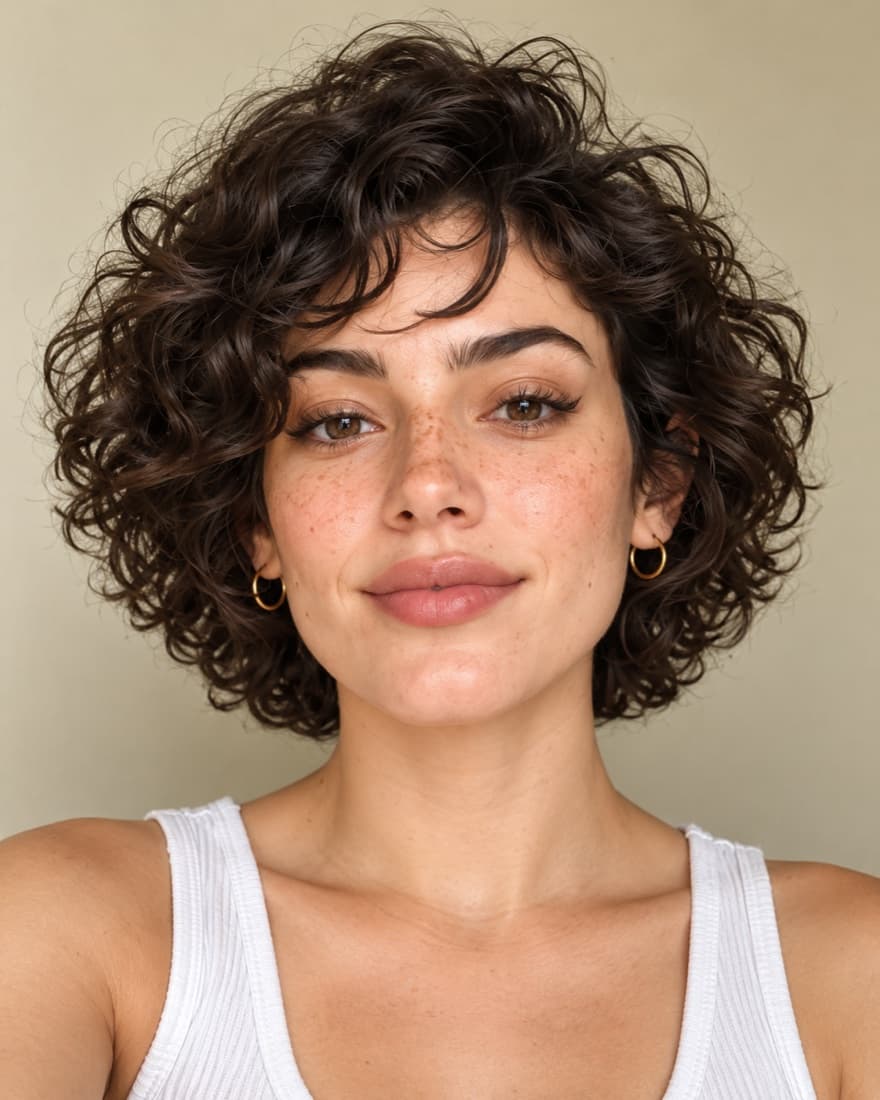
How do you calculate facial proportions?
Short answer: A facial proportions calculator divides facial distances to get ratios. FaceTwin measures seven on one selfie: four against 1.618 and three against 1:1. In 1,196 faces the median face length-to-width ratio is 1.449, and only 14% are within 5% of the golden ratio. Free, measured on your device.
Facial proportions are distances on the face divided by each other, so they do not depend on photo size. FaceTwin finds 68 landmarks on your selfie and calculates seven ratios. Four are compared with the golden ratio 1.618: face length to face width, cheekbone width to the outer eye width, the eye-to-mouth distance against the nose, and nose-to-chin against lip-to-chin. Three are compared with 1:1: the middle facial third against the lower third, mouth width against the distance between the pupils, and brow width against jaw width. For each ratio you see your value, the ideal and how close you are. The useful part is the context: in 1,196 reference faces the median face length-to-width ratio is 1.449, not 1.618, and only 14% land within 5% of the golden ratio. Everything is measured in your browser and nothing is uploaded.
- 7 ratios: 4 vs 1.618, 3 vs 1:1
- Median length ÷ width: 1.449
- Only 14% within 5% of φ on length ÷ width
- Measured on-device from 68 landmarks
How to use it
- Upload a selfie or take one: a front-facing, well-lit photo of yourself, no glasses, neutral expression.
- Wait a few seconds: the face model finds 68 landmarks in your browser; the photo is not uploaded.
- Read the seven golden-ratio proportions and how close each is to 1.618.
- Compare with the reference medians shown under each ratio.
Related measurements
The seven facial proportions and what is typical
Calculators online usually list the ideal and stop there. This table adds what 1,196 measured faces actually show, which is the fairest way to read your own numbers.
| Ratio | Ideal | Median in 1,196 faces | Within 5% of ideal |
|---|---|---|---|
| Face length ÷ width | 1.618 | 1.449 (women 1.47, men 1.43) | 14% |
| Cheekbone width ÷ outer eye width | 1.618 | 1.631 | 85% |
| Eyes–mouth ÷ nose length | 1.618 | 1.552 | 31% |
| Nose–chin ÷ lip–chin | 1.618 | 1.486 | 21.8% |
| Middle third ÷ lower third | 1.0 | 1.12 | 19.9% |
| Mouth width ÷ pupil distance | 1.0 | 0.873 | 21.7% |
| Brow width ÷ jaw width | 1.0 | 0.99 | 81.5% |
Two ratios — cheekbones to eyes and brows to jaw — sit close to the ideal for most people. The others vary widely, and being outside 5% of the ideal is the normal case, not the exception.
Face length to width: the ratio people ask about most
The face length-to-width ratio is the one most often quoted as “should be 1.618”. Real faces disagree: the middle 80% of the reference set falls between 1.35 and 1.552, with a median of 1.449. Women’s faces in the set are slightly longer relative to width (median 1.47) than men’s (1.43).
| Your length ÷ width | What it usually means |
|---|---|
| Below 1.35 | A shorter, wider face — often read as round or square |
| 1.35–1.55 | The middle 80% of faces — typical oval proportions |
| Above 1.55 | A longer face — often read as oblong |
| About 1.618 | The classical ideal; reached within 5% by 14% of faces |
How to measure facial proportions accurately
- Hold the camera at eye level and at least an arm’s length away. Close-up phone lenses make the nose and lower face look bigger and change every vertical ratio.
- Look straight ahead. A slight turn shrinks one side of the face and lowers the width-based ratios.
- Pull hair back from the forehead and jaw so the outline is visible, and keep a neutral, closed-mouth expression.
- Repeat with two or three photos. Ratios that stay within a few hundredths are reliable; the rest are the photo.
Measuring by hand with a ruler on a printed photo works too, but it is slow and the landmark positions are hard to judge. The calculator places all 68 points the same way every time.
Facial proportions calculators compared
| FaceTwin | Typical online calculator | |
|---|---|---|
| Ratios measured | Seven, each shown with your value | One to three, often only length ÷ width |
| Real-world ranges | Yes, from 1,196 measured faces | Usually only the ideal |
| Photo handling | Measured in your browser, never uploaded | Uploaded to a server |
| Price | Free | Free with ads, or behind a paywall |
What the numbers mean — and what they don’t
Proportions describe geometry. Faces far from every ideal are common and are found attractive all the time, because expression, skin, hair and style shape how a face is seen far more than a ratio does. Use the calculator for curiosity, for choosing frames or haircuts, or for drawing — not to judge yourself. It is for adults using their own photo, and it is entertainment, not a measure of worth.
Frequently asked questions
What are ideal facial proportions?
Classical guides use 1.618 for four ratios (such as face length to width) and 1:1 for three (such as the facial thirds). Real faces rarely hit them: in 1,196 reference faces only 14% are within 5% of 1.618 on length to width.
Is the facial proportions calculator free?
Yes. All seven ratios, your values and the reference ranges are free, with no account and no ads.
Does it upload my photo?
No. The 68 landmarks and every ratio are calculated in your browser, and the photo never leaves your device.
What is a normal face length to width ratio?
Around 1.35 to 1.55. The median in the reference set is 1.449; above about 1.53 a face tends to read as oblong and below about 1.38 with a wide jaw as round.
Why do my proportions change between photos?
Lens distance, head tilt and expression move landmarks. A close selfie enlarges the lower face. Use eye-level photos from arm’s length and compare several.
Is my photo uploaded?
Not for local lookalikes or face analysis: the model runs in your browser, so your selfie, landmarks and descriptor stay on your device. AI portraits, including the first free one, and full reports send your photo through our server to the AI provider after a free first-portrait request or a credit purchase, and separate upload consent. Reports also send your numeric measurements. FaceTwin does not save the original photo; it is discarded from request memory after processing.
More from the same selfie
Related by topic
Face proportions
The data behind the scores: FaceTwin facts · face shape statistics
Last updated 2026-10-18. FaceTwin is for entertainment and is not identity recognition, medical or cosmetic advice.