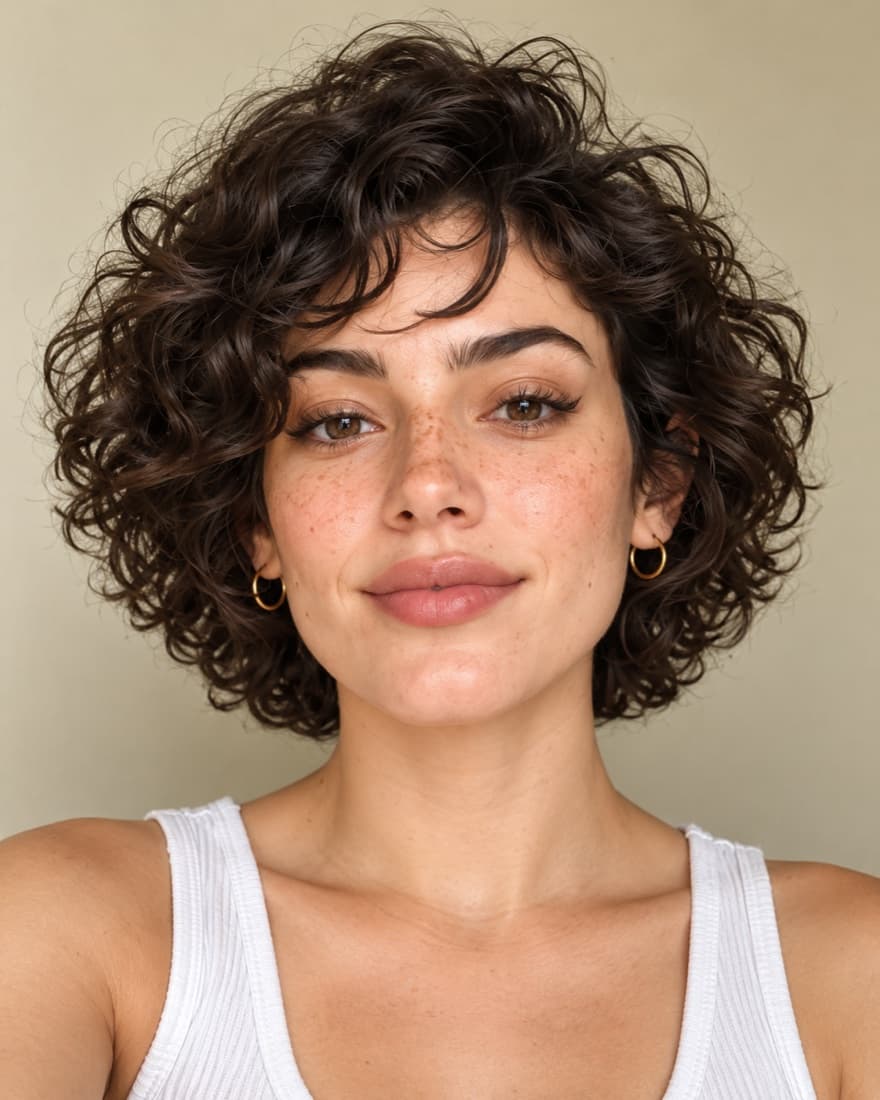
How is facial width-to-height ratio (FWHR) calculated?
FWHR is facial width divided by facial height. FaceTwin finds 68 landmarks on your selfie in the browser, measures the width between the two cheekbone points (the widest part of the face outline at cheekbone level), and divides it by the vertical distance from the brow line to the top of the upper lip. In our reference set of 1,196 faces the median is 1.681, the middle half of faces fall between 1.61 and 1.762, and the middle 80% between 1.542 and 1.84. Research papers use slightly different height endpoints, so the absolute number differs between tools: compare your result with the range from the same tool, not with a figure from a paper. The photo never leaves your device.
- Median 1.681 in 1,196 faces
- Middle half: 1.61–1.762
- Width ÷ brow-to-upper-lip height
- No upload, no sign-up
Related measurements
What FWHR is and how we measure it
Facial width-to-height ratio compares how wide a face is with how tall its upper part is. In the research literature the width is the bizygomatic breadth, the distance between the two cheekbones, and the height is the distance from the upper lip to a point near the brows or the upper eyelids. A larger number means a wider, more compact upper face; a smaller number means a narrower, longer one.
FaceTwin uses one fixed definition so every photo is measured the same way. Width is the cheekbone-to-cheekbone distance on the face outline (landmarks 2 and 16 of the 68-point model). Height is measured from the average level of the two eyebrows down to the upper-lip landmark. The ratio is width divided by height, rounded to three decimals.
| Where it is used | Width | Height | What it means for you |
|---|---|---|---|
| FaceTwin | Cheekbone to cheekbone | Brow line to upper lip | Compare with the FaceTwin range below |
| Many research papers | Bizygomatic width | Upper-face height (often upper eyelids or the nasion to upper lip) | Different endpoint, so a different absolute value |
| Other online calculators | Usually the same width | Varies by tool | Only compare numbers from the same tool |
This is the main reason one person can see 1.7 on one site and 2.0 on another: the numerator is similar, the denominator is not. A tool that measures height from the upper eyelids gets a smaller height and a larger ratio. As of November 2026, one other free browser calculator we checked states the same thing on its own page, that studies use different endpoints so published figures can disagree.
Where your number sits: the distribution in 1,196 faces
We measured FWHR on 1,196 reference portraits of public figures using the exact method above. The spread is narrow: most faces land within a tenth either side of the median.
| Group | 10th pct | 25th pct | Median | 75th pct | 90th pct |
|---|---|---|---|---|---|
| Everyone | 1.542 | 1.61 | 1.681 | 1.762 | 1.84 |
| Women | 1.537 | 1.607 | 1.675 | 1.751 | 1.805 |
| Men | 1.549 | 1.613 | 1.686 | 1.775 | 1.863 |
The medians for women (1.675) and men (1.686) are almost the same in our set; men have a slightly longer upper tail (90th percentile 1.863 against 1.805). The panel under the tool tells you whether your value is typical (inside the middle half), higher or lower than most, or beyond the 10th or 90th percentile. A value outside the middle half is not a flaw: it is a description of proportion.
How the camera changes your FWHR
FWHR is one of the most camera-sensitive numbers a selfie can give you, because it divides a horizontal distance by a vertical one and both react to the lens and your pose.
| What changes | Effect on FWHR | Fix |
|---|---|---|
| Phone held close (under about 40 cm) | The middle of the face magnifies, which distorts width against height | Arm’s length or further, then crop |
| Chin tucked or camera above eye level | Brow-to-lip distance shortens, so FWHR rises | Camera at eye level |
| Chin raised or camera below | Brow-to-lip distance lengthens, so FWHR falls | Camera at eye level |
| Head turned slightly | Apparent width shrinks on one side | Both ears at the same distance from the lens |
| Smiling widely or raised brows | Lip and brow positions move, so the height changes | Relaxed, neutral expression |
The panel notes that a slight upward tilt of the head raises the ratio. Take two or three photos, test each, and treat the spread as your real range. If the numbers differ by more than a few hundredths, it is the photo, not your face.
What FWHR does and does not tell you
FWHR has attracted attention because some studies have linked it to perceived traits, and because looksmaxxing forums use it as a quick shape descriptor. The evidence is mixed: results vary between samples and methods, and effects tend to be small. Body fat and age change the face’s width, so a single photo reflects the moment as well as the skeleton.
We therefore use FWHR as what it is, a descriptive measurement. It does not rate attractiveness, personality or ability, and FaceTwin does not claim that a higher or lower number is better. It sits next to the other ratios on the same page so you can see how your face is proportioned overall.
- Higher than the median: a wider, more compact upper face in this photo.
- Near the median: a typical balance of width and upper-face height.
- Lower than the median: a narrower, longer upper face in this photo.
Entertainment, not a measure of worth. For adults, using your own photo.
How to get a reliable reading
- Face a window for even light and hold the phone at eye level, at arm’s length or further.
- Look straight into the lens with a relaxed mouth. Keep the head level; do not tilt the chin up or down.
- Pull hair back off the brows and forehead so the brow line is visible.
- Take two or three shots and test each. Use the middle value.
- Compare only with FaceTwin’s own range. Numbers from other tools use other height endpoints.
Frequently asked questions
What is a good FWHR?
There is no “good” value. In our 1,196-face reference set the median is 1.681 and the middle half sit between 1.61 and 1.762. The calculator tells you whether yours is typical, higher or lower, and that is a description of proportion, not a grade.
Why does my FWHR differ between calculators?
Tools define the height differently: some measure to the upper eyelids, some to the brows or nasion, some to the upper lip from the brow line as we do. Width is usually cheekbone to cheekbone. A different height gives a different absolute number, so compare results from the same tool only.
Can my FWHR change?
A little. Body fat, age, head tilt, lens distance and expression all shift it. Take several photos under the same conditions to see your own spread before you read anything into a difference.
Is a higher FWHR more attractive?
We make no such claim. Studies on FWHR and perceived traits are mixed and the effects are small. FWHR here is a descriptive measurement and part of an entertainment tool.
Which landmarks does FaceTwin use?
Width uses the two cheekbone points on the 68-landmark face outline. Height runs from the average level of the two eyebrows to the upper-lip landmark. The measurement lines are drawn on your photo so you can check them.
Do I need to sign up or pay?
No. The FWHR calculator and the other ratios are free and unlimited, with no account. Only optional AI portraits cost credits.
Is my photo uploaded?
Not for local lookalikes or face analysis: the model runs in your browser, so your selfie, landmarks and descriptor stay on your device. AI portraits, including the first free one, and full reports send your photo through our server to the AI provider after a free first-portrait request or a credit purchase, and separate upload consent. Reports also send your numeric measurements. FaceTwin does not save the original photo; it is discarded from request memory after processing.
More from the same selfie
Related by topic
Face proportions
The data behind the scores: FaceTwin facts · face shape statistics
Last updated 2026-10-18. FaceTwin is for entertainment and is not identity recognition, medical or cosmetic advice.