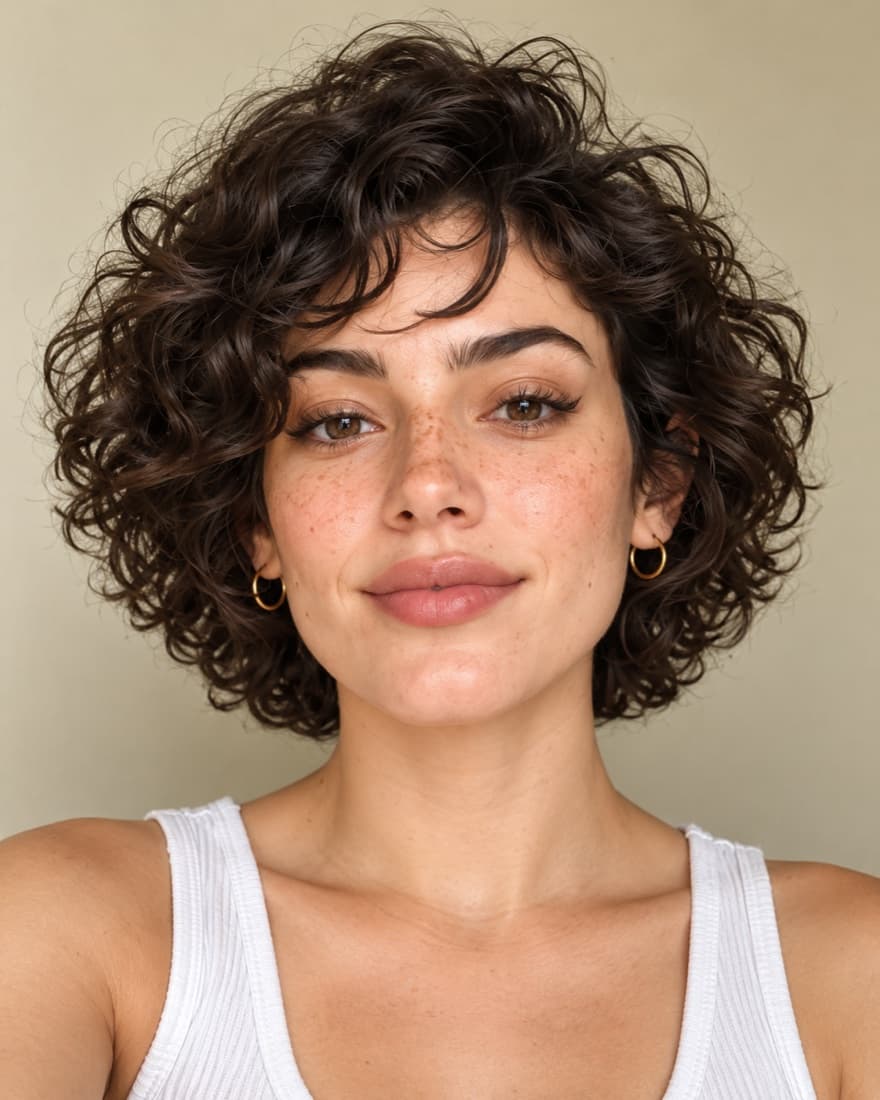
What is the difference between an oblong and an oval face?
Short answer: Oblong and oval faces are both longer than wide, but an oblong face is longer, with brow, cheeks and jaw close in width; an oval narrows gently to a rounded chin. FaceTwin calls a face oblong when length is 1.53 times cheekbone width or more. Of 1,196 faces, 52% were oval and 16.5% oblong.
Both shapes are longer than they are wide and taper gently, but an oblong face is clearly longer and keeps similar widths at the brow, cheekbones and jaw, while an oval face is a little shorter and narrows softly from the cheekbones to a rounded chin. FaceTwin draws the line by measurement: when face length (with the forehead estimated as one third) is 1.53 times the cheekbone width or more, the face is called oblong; most faces below that with no wide jaw or wide brow are oval. In our 1,196 reference faces, the median ratio was 1.449. Oval was the most common shape at 52%, oblong second at 16.5% (22% of women, 11.6% of men). Faces near 1.5 can read as either, depending on the photo.
- Oblong: length ≥1.53× cheekbone width
- Median face 1.449× (women 1.47, men 1.43)
- Oval 52% · oblong 16.5% of 1,196 faces
- Oblong 22% of women, 11.6% of men
How to use it
- Upload a selfie or take one: a front-facing, well-lit photo of yourself, no glasses, neutral expression.
- Wait a few seconds: the face model finds 68 landmarks in your browser; the photo is not uploaded.
- Read your face shape and the three ratios behind it.
- Scroll to the haircuts and glasses that suit that shape.
Face shape guides
Oblong vs oval at a glance
| Oval | Oblong | |
|---|---|---|
| Length ÷ cheekbone width | Moderate; most faces below 1.53 | 1.53 or more |
| Widest point | Cheekbones, narrowing gently above and below | Brow, cheeks and jaw close in width |
| Chin | Softly rounded, narrower than the forehead | Can be squarer or longer |
| Overall impression | Balanced egg outline | Long, straight-sided outline |
| Also called | Egg-shaped | Long, rectangular |
| Share of 1,196 faces | 52% (women 50.6%, men 53.4%) | 16.5% (women 22%, men 11.6%) |
| Styling goal | Keep the balance | Add width, shorten visually |
The measurement that separates them
Stylists describe the difference in words, which is why people argue about it. FaceTwin uses numbers. It measures face length from the chin to the brow line and adds one estimated forehead third (a 68-point landmark model cannot see the hairline), then divides by the width across the cheekbones.
| Length ÷ width | What it usually means |
|---|---|
| Below about 1.38 with a wide jaw | Round |
| About 1.40–1.52 | Oval for most faces (median 1.449) |
| 1.53 or more | Oblong |
The 1.53 line is not a law of nature; it is where our reference set splits sensibly, chosen because the landmark model smooths outlines and textbook ratios would call almost everyone oval. A face at 1.51 and one at 1.54 look very similar, and two photos of the same person can land on either side.
How to tell at home
- Take a straight-on photo at eye level, about an arm’s length away, hair pulled back.
- Measure from the hairline to the chin, and across the widest part of the cheekbones.
- Divide length by width. Around 1.5 or more with similar widths top to bottom suggests oblong; a bit less, with a narrower chin, suggests oval.
- Check the jaw: if the jaw is almost as wide as the cheekbones and the face is long, that leans oblong.
A tape measure on a real face gives larger lengths than a landmark model because it includes the full forehead, so home ratios run higher than FaceTwin’s. Compare the shape, not the exact number.
Hairstyles: oblong vs oval
| Goal | Oval face | Oblong face |
|---|---|---|
| Length of cut | Almost anything works | Chin to shoulder length; avoid very long, flat hair |
| Fringe | Optional | Helpful: a fringe or curtain bangs shortens the face |
| Volume | Even | At the sides, not on top |
| Parting | Centre or side | Side parting breaks up length |
| Short hair (men) | Most cuts | Avoid tall quiffs; keep the sides a little fuller |
Glasses follow the same logic: an oval face suits most frames, while an oblong face looks balanced in deeper frames with a strong top line that add width.
Glasses, beards and makeup for each shape
| Oval face | Oblong face | |
|---|---|---|
| Glasses | Most frames; keep them about as wide as the face | Deep or oversized frames with a strong top line; avoid small, narrow frames |
| Beard | Most styles | Fuller at the sides, shorter at the chin, to avoid adding length |
| Blush and contour | Light, on the cheekbones | Applied horizontally across the cheeks; a little contour at the hairline and chin can shorten the face |
| Earrings | Most styles | Studs, hoops or wide shapes rather than long drops |
These are styling conventions, not rules. Both shapes are common and both look good in a wide range of styles; the tips simply help if you want to make a long face look shorter or keep an oval balanced.
Why the two get confused
- Both are longer than wide, so the difference is a matter of degree.
- Hair hides the forehead, which is part of the length.
- Close-up selfies stretch the face; shots from far away compress it.
- Many faces genuinely sit near the line and could be called either.
If the detector says oblong and you think oval, look at the measured ratio it shows. If it is close to 1.53, both answers are fair, and styling advice for either will work.
Frequently asked questions
Is oblong the same as long or rectangular?
Yes. Oblong, long and rectangular all describe a face that is clearly longer than wide with similar widths at the brow, cheeks and jaw.
Which is more common, oval or oblong?
Oval. It was 52% of our 1,196 reference faces; oblong was second at 16.5%.
Are oblong faces more common in women?
In our data, yes: 22% of the women and 11.6% of the men were oblong.
What ratio is an oblong face?
FaceTwin calls a face oblong when its estimated length is 1.53 times the cheekbone width or more. The median face is 1.449.
Can a face be both oval and oblong?
Practically, yes. Faces near the line can read as either depending on the photo. Styling advice for both overlaps a lot.
Is an oval face better than an oblong face?
No. Oval is often called versatile for styling, but no face shape is better. Shape describes outline, not attractiveness or worth.
Do oblong faces suit fringes?
Usually, yes. A fringe or curtain bangs shortens a long face visually; side volume adds width.
Why does my face shape change between photos?
Lens distance, head angle and hair change the measured outline. Take a straight-on photo at arm’s length with hair pulled back.
How does FaceTwin measure face length without the hairline?
The landmark model has no hairline point, so it estimates the forehead as one third of the face and adds it to the chin-to-brow height.
Does the tool suggest haircuts?
Yes. The face shape result includes haircut and glasses ideas for your shape, and the optional AI try-on lets you preview cuts.
Is my photo uploaded?
Not for local lookalikes or face analysis: the model runs in your browser, so your selfie, landmarks and descriptor stay on your device. AI portraits, including the first free one, and full reports send your photo through our server to the AI provider after a free first-portrait request or a credit purchase, and separate upload consent. Reports also send your numeric measurements. FaceTwin does not save the original photo; it is discarded from request memory after processing.
More from the same selfie
Related by topic
Face shapes
The data behind the scores: FaceTwin facts · face shape statistics
Last updated 2026-10-18. FaceTwin is for entertainment and is not identity recognition, medical or cosmetic advice.